- Table of Contents
- Key Takeaways
- What Are AI Agents?
- The Planning Phase: How AI Agents Think Ahead
- How Planning Works
- Planning Frameworks and Reasoning
- The Action Phase: Execution and Decision-Making
- Execution and Monitoring
- Decision-Making During Action
- Real-Time Adaptation: Learning on the Fly
- How Real-Time Adaptation Works
- Mechanisms of Adaptation
- Real-World Applications
- Customer Service Agents
- Autonomous Vehicles
- Supply Chain Optimization
- Challenges and Limitations
- Reasoning Limitations
- Environmental Unpredictability
- Resource Constraints
- Feedback Interpretation
- Goal Specification
- The Future of AI Agents
- Frequently Asked Questions
- What's the difference between an AI agent and a chatbot?
- Can AI agents truly learn, or are they just pattern matching?
- How do AI agents handle situations they weren't trained for?
- What happens when an AI agent's plan fails?
- About the Author
“`html
How AI Agents Plan, Act, and Adapt in Real Time
Table of Contents
Key Takeaways
- AI agents operate through three interconnected phases: planning, action, and real-time adaptation
- Planning involves goal decomposition: Breaking complex tasks into manageable steps using reasoning frameworks
- Action execution requires decision-Making: Agents evaluate options and select strategies based on current context
- Real-time adaptation is critical: Successful agents continuously learn from outcomes and adjust their approaches
- Current limitations exist: Including resource constraints, reasoning errors, and unpredictable environments
What Are AI Agents?
AI agents represent a significant evolution in artificial intelligence. Unlike traditional AI systems that process inputs and generate outputs, AI agents are autonomous systems that perceive their environment, make decisions, and take actions toward specific goals. They operate with a degree of independence and can respond dynamically to changing circumstances.
Think of an AI agent as a decision-maker with agency. It’s not simply executing pre-programmed instructions—it’s evaluating situations, reasoning through options, and choosing courses of action. This fundamental shift enables AI systems to handle complex, unpredictable scenarios that would be impossible to script manually.
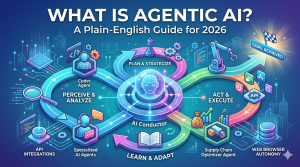
The capability that makes modern AI agents particularly powerful is their ability to plan, act, and adapt in real time. These three components work together in a continuous cycle, creating systems that can tackle sophisticated problems across industries.
The Planning Phase: How AI Agents Think Ahead
Before an AI agent takes any action, it engages in a planning phase. This is where the agent’s reasoning capabilities become evident. Planning is the process of decomposing goals into actionable steps and identifying the sequence of actions most likely to achieve desired outcomes.
How Planning Works
During the planning phase, AI agents typically follow these steps:
- Goal Definition: The agent clarifies what needs to be accomplished and establishes success criteria
- Environmental Analysis: The agent assesses the current state, available resources, and potential constraints
- Option Generation: The agent identifies multiple possible approaches to reach the goal
- Path Selection: The agent evaluates options and selects the most promising strategy based on likelihood of success
- Step Breakdown: The agent creates a detailed sequence of intermediate steps required for execution
Planning Frameworks and Reasoning
Modern AI agents use sophisticated reasoning frameworks to make planning decisions. Chain-of-thought reasoning allows agents to explicitly work through problems step-by-step, similar to how humans think through complex challenges. This transparency in reasoning helps both the AI agent and human observers understand why particular plans are selected.
Some agents employ hierarchical planning, breaking large goals into progressively smaller subgoals. Other systems use probabilistic reasoning to evaluate the likelihood of success for different paths. The specific approach depends on the agent’s architecture and the nature of the task.
The planning phase doesn’t always result in a single rigid plan. Instead, modern AI agents often develop flexible strategies with multiple contingency pathways. This flexibility proves essential when real-World conditions deviate from initial assumptions.
The Action Phase: Execution and Decision-Making
Once planning is complete, AI agents move into the action phase. This is where theoretical strategies become concrete operations. The action phase involves executing planned steps while continuously monitoring outcomes and making tactical adjustments.
Execution and Monitoring
During action execution, agents:
- Implement the planned steps in sequence
- Continuously monitor the results of each action
- Assess whether outcomes align with expectations
- Evaluate feedback from the environment
- Compare current progress against predetermined success metrics
This continuous monitoring is crucial. Agents don’t blindly execute plans—they actively observe whether their actions are producing intended results. If an action produces unexpected outcomes, this information feeds directly into the adaptation process.
Decision-Making During Action
The action phase isn’t purely mechanical. Agents make numerous micro-decisions throughout execution:
- Timing decisions: When is the optimal moment to execute the next step?
- Resource allocation: How should available resources be distributed across competing needs?
- Risk assessment: Which approach carries acceptable risk given current circumstances?
- Interaction decisions: Should the agent communicate with other systems or humans?
- Continuation decisions: Should the current approach continue, or does the situation warrant a strategy change?
These decisions happen rapidly and continuously. The agent’s decision-making quality depends heavily on the quality of information available, the sophistication of its evaluation models, and its capacity to process information quickly.
Real-Time Adaptation: Learning on the Fly
Real-time adaptation is perhaps the most distinctive capability of modern AI agents. Rather than rigidly following predetermined plans, agents continuously learn from their experiences and adjust their approaches mid-execution.
How Real-Time Adaptation Works
The adaptation process follows a feedback loop:
- Observation: The agent collects data about action outcomes and environmental changes
- Analysis: The agent analyzes whether results matched predictions
- Learning: The agent updates its understanding of what strategies work in current conditions
- Adjustment: The agent modifies its approach based on new insights
- Re-evaluation: The agent tests the adjusted strategy and observes new results
This cycle can repeat multiple times during a single task execution. What makes this “real-time” is that adaptation happens during action, not weeks or months later. If an agent discovers that its initial approach isn’t working, it can pivot immediately rather than continuing with a failing strategy.
Mechanisms of Adaptation
AI agents employ several adaptation mechanisms:
- Parameter adjustment: Fine-tuning decision thresholds or weighting factors to reflect new conditions
- Strategy switching: Abandoning the current approach entirely and adopting a different strategy
- Goal refinement: Modifying intermediate objectives based on what’s been learned
- Model updating: Revising assumptions about how the environment works
- Resource reallocation: Shifting resources from less productive to more productive activities
The effectiveness of adaptation depends on how quickly agents can detect that changes are needed and how diverse their response options are. Agents with limited response options may struggle even when they recognize that adaptation is necessary.
Real-World Applications
Understanding the abstract concepts of planning, action, and adaptation becomes clearer when examining real-world applications. Here’s how these principles work in practice:
Customer Service Agents
Planning: When a customer contacts support, the agent plans an investigation sequence—gathering ticket history, identifying the issue category, determining appropriate resources.
Action: The agent executes the plan by retrieving relevant information, running diagnostics, and attempting solutions.
Adaptation: If initial troubleshooting fails, the agent adapts by trying alternative approaches, escalating to specialist teams, or providing workarounds while the primary solution is developed.
Autonomous Vehicles
Planning: Route selection considering traffic patterns, construction, and time constraints.
Action: Executing driving decisions—acceleration, deceleration, steering, signaling.
Adaptation: Responding to unexpected obstacles, changing traffic conditions, or pedestrian behavior in real time.
Supply Chain Optimization
Planning: Designing inventory strategies and distribution networks.
Action: Placing orders, routing shipments, managing warehouse operations.
Adaptation: Responding to demand fluctuations, supply disruptions, or transportation delays.
Challenges and Limitations
While AI agents demonstrate remarkable capabilities, they face significant limitations that affect their effectiveness:
Reasoning Limitations
Current AI agents can struggle with complex reasoning tasks involving multiple interdependent factors. They may miss subtle connections or fail to recognize when their assumptions are incorrect. Long chains of reasoning can accumulate errors—what researchers call “error propagation.”
Environmental Unpredictability
Real-world environments often contain surprises that agents didn’t anticipate during planning. Truly novel situations can overwhelm agents that were trained on historical data. When an agent encounters something it has never seen before, its adaptation mechanisms may prove insufficient.
Resource Constraints
Planning and adaptation both require computational resources. More sophisticated reasoning takes longer, which becomes problematic when decisions need to be made quickly. Agents must balance reasoning depth against response speed.
Feedback Interpretation
Agents depend on reliable feedback to adapt effectively. In complex environments with delayed consequences, an agent may struggle to connect its actions to outcomes. Noisy or misleading feedback can actually cause agents to learn incorrect lessons.
Goal Specification
Well-defined goals are essential for effective planning. However, many real-world objectives are ambiguous or contain implicit requirements that humans understand intuitively. Communicating complex goals to AI agents remains challenging.
The Future of AI Agents
The field of agentic AI is advancing rapidly. Several developments are on the horizon that will likely enhance agent capabilities:
Improved reasoning architectures will enable agents to work through more complex problems with greater accuracy. Better integration with knowledge systems will provide agents with more reliable information for decision-making. Enhanced adaptation mechanisms will help agents respond more effectively to novel situations.
We’re also seeing progress in multi-agent systems where multiple agents collaborate, each with specialized capabilities. This approach can overcome limitations that individual agents face.
The next frontier involves developing agents with greater explainability—systems where humans can understand not just what the agent did, but why it made those decisions. This transparency will be essential for deploying agents in high-stakes domains like healthcare or finance.
Frequently Asked Questions
What’s the difference between an AI agent and a chatbot?
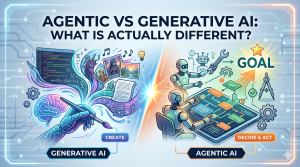
Chatbots primarily respond to user queries by retrieving information or generating relevant text. AI agents are more autonomous—they can set their own subgoals, take actions in external systems, and work toward objectives without continuous human direction. A chatbot answers questions; an agent works toward accomplishing goals. A customer service agent might autonomously investigate a problem, run diagnostics, and place orders for replacement parts—going far beyond what a chatbot can do.
Can AI agents truly learn, or are they just pattern matching?
This question gets at deep philosophical issues about what “learning” means. Modern AI agents certainly update their internal models based on experience—that’s a form of learning. However, whether this constitutes “true” learning equivalent to human learning is debatable. What’s undeniable is that agents can improve their performance on tasks through experience. They can identify patterns that work and adjust their strategies accordingly.
How do AI agents handle situations they weren’t trained for?
This is one of the major challenges for current agents. When agents encounter truly novel situations, they often struggle because their training data doesn’t cover those scenarios. However, sophisticated agents can sometimes handle novelty by breaking novel problems into familiar components, drawing analogies to similar past experiences, or explicitly acknowledging uncertainty and requesting human guidance. The better an agent’s fundamental reasoning capabilities, the better it handles genuinely new situations.
What happens when an AI agent’s plan fails?
A good agent recognizes plan failure and initiates adaptation. It might try a different approach, break the goal into smaller steps, seek additional resources, or request human assistance. Poor agents might get stuck repeating the same failing approach. The sophistication of failure detection and response is a key differentiator between effective and ineffective agents. This is why real-time monitoring and continuous adaptation are so critical.
“`