- Table of Contents
- Key Takeaways
- What is Agentic AI?
- How Agentic AI Works
- The Core Components
- The Execution Process
- Key Characteristics of Agentic AI
- Autonomy
- Goal-Orientation
- Persistence
- Adaptability
- Tool Usage
- Real-World Applications in 2026
- Customer Service and Support
- Sales and Business Development
- Content Creation and Research
- Business Process Automation
- Data Analysis and Business Intelligence
- Benefits and Challenges
- Significant Benefits
- Current Challenges
- The Future of Agentic AI
- What's Coming in Late 2026 and Beyond
- Frequently Asked Questions
- Q: How is agentic AI different from traditional chatbots?
- Q: Do I need to replace my entire tech stack to use agentic AI?
- Q: What's the biggest risk with deploying agentic AI?
- Q: Is agentic AI secure? Can it be hacked?
- About the Author
“`html
Agentic AI 101: Everything You Need to Know in 2026
Table of Contents
Key Takeaways
- Agentic AI refers to artificial intelligence systems that can autonomously plan, execute, and adapt to achieve specific goals without continuous human intervention.
- These systems combine large language models with tool integration, memory systems, and decision-making frameworks.
- Common applications include customer service automation, business process optimization, research assistance, and complex task management.
- While agentic AI offers significant efficiency gains, it also presents challenges in safety, accountability, and control.
- The field is rapidly evolving, with 2026 marking a turning point toward more capable and specialized agents.
What is Agentic AI?
Agentic AI represents a fundamental shift in how we approach artificial intelligence. Unlike traditional AI systems that respond to specific prompts or follow predetermined decision trees, agentic AI systems are autonomous entities capable of independently planning, executing, and monitoring complex tasks to achieve defined objectives.
Think of agentic AI as the difference between a calculator (which requires you to input every operation) and a financial advisor (who understands your goals and independently researches options, makes recommendations, and executes trades on your behalf). The agentic AI system doesn’t wait for step-by-step instructions—it understands the goal and figures out how to get there.
In 2026, agentic AI has evolved from theoretical research into practical business applications affecting millions of daily transactions and decisions across industries. These systems are no longer confined to labs; they’re reshaping how companies operate.
How Agentic AI Works
The Core Components
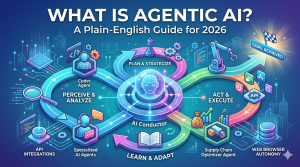
An agentic AI system typically consists of several interconnected components working in harmony:
- Foundation Model: Usually a large language model that understands language, context, and reasoning
- Tool Integration Layer: Connections to external APIs, databases, software, and systems the agent can control
- Memory System: Short-term context of current tasks and long-term knowledge bases for decision-making
- Planning Engine: The ability to break down complex goals into actionable steps
- Feedback Loop: Mechanisms to monitor progress, detect errors, and adjust course
The Execution Process
When given an objective, an agentic AI system follows this general process:
1. Goal Interpretation: The system receives a goal and breaks it down into sub-objectives. If you ask it to “increase customer satisfaction scores by 15%,” it understands this requires analyzing current satisfaction data, identifying pain points, and implementing solutions.
2. Planning and Strategy: The agent creates a multi-step plan, considering various approaches and their potential outcomes. It weighs different strategies based on available resources, constraints, and historical data.
3. Tool Selection and Execution: The agent identifies which tools and APIs it needs to use and begins executing tasks. It might query databases, call APIs, process data, or interact with other systems.
4. Monitoring and Adaptation: Throughout execution, the agent monitors results against expected outcomes. If it encounters obstacles or discovers new information, it adapts its approach in real-time.
5. Reporting and Iteration: Once tasks complete, the agent documents results and identifies improvement opportunities for future similar tasks.
Key Characteristics of Agentic AI
Autonomy
True agentic AI operates with minimal human oversight. Rather than requiring approval for each action, these systems are trusted to make decisions within defined boundaries. This autonomy is what makes them powerful—and what makes governance so important.
Goal-Orientation
Agentic systems are fundamentally goal-driven. They’re designed around achieving specific objectives rather than simply responding to inputs. This means they can generate novel solutions and unexpected approaches to problems.
Persistence
Unlike traditional chatbots that reset with each new conversation, agentic AI systems maintain context across interactions. They remember what they’ve learned, what has and hasn’t worked, and build on past experiences.
Adaptability
These systems can adjust their strategies when circumstances change. If a preferred approach fails, they pivot to alternatives without requiring human intervention.
Tool Usage
Agentic AI doesn’t just exist in isolation—it integrates with other software, systems, and data sources. Its power comes partly from its ability to leverage external tools and information.
Real-World Applications in 2026
Customer Service and Support
AI agents now handle complex customer issues that previously required human expertise. They can access order histories, understand customer context, propose solutions, and execute refunds or replacements without escalation. The difference from old chatbots? These agents actually understand nuance and can handle ambiguous requests.
Sales and Business Development
Agentic AI systems research potential clients, identify buying signals, personalize outreach, and even participate in initial negotiations. Sales teams report that these agents handle qualifying and nurturing activities that previously consumed 60-70% of their time.
Content Creation and Research
Rather than generating a single article, agentic AI systems can research topics comprehensively, synthesize information from multiple sources, identify knowledge gaps, and create entire content ecosystems. They understand SEO, audience needs, and content strategy.
Business Process Automation
From procurement to HR onboarding, agents are automating complex, multi-step processes that involve decision-making, cross-system coordination, and exception handling. They reduce processing time from days to minutes.
Data Analysis and Business Intelligence
Agentic systems can autonomously investigate business questions, analyze datasets, create visualizations, identify trends, and recommend actions—all without being asked for every intermediate step.
Benefits and Challenges
Significant Benefits
- Massive Efficiency Gains: Tasks that took hours now take minutes, freeing humans for higher-value work
- 24/7 Operations: Agents don’t sleep, don’t get tired, and don’t have capacity constraints like humans
- Consistency: Agents apply rules and processes consistently without fatigue-induced errors
- Scalability: One agent can handle workflows across thousands of instances simultaneously
- Cost Reduction: Lower operational costs as routine tasks become automated
- Enhanced Decision-Making: Agents can process more data and consider more variables than humans
Current Challenges
- Control and Alignment: Ensuring agents pursue intended goals without unintended consequences remains difficult
- Accountability: Who is responsible when an agent makes an error affecting customers or operations?
- Transparency: Understanding why an agent made a specific decision is increasingly complex
- Security Risks: More autonomous systems mean more potential attack surfaces
- Bias and Fairness: Agents can perpetuate or amplify biases in training data
- Integration Complexity: Integrating agents with legacy systems and ensuring compatibility remains challenging
The Future of Agentic AI
What’s Coming in Late 2026 and Beyond
Specialized Agents: Rather than general-purpose systems, we’re seeing emergence of domain-specific agents optimized for particular industries, functions, or problem types. An agent designed for medical billing operates differently than one designed for supply chain optimization.
Multi-Agent Systems: Complex problems increasingly require multiple agents with different specialties collaborating. These systems communicate with each other, delegate tasks, and work toward shared objectives.
Better Governance Frameworks: Organizations are developing better systems for monitoring agent behavior, setting boundaries, and maintaining human oversight without losing the efficiency benefits.
Improved Explainability: New techniques are making agent decision-making more transparent and understandable to humans—critical for regulated industries.
Integration with Physical Systems: Agentic AI is increasingly controlling physical systems, from warehouse robotics to manufacturing equipment, creating new possibilities and new risks.
Frequently Asked Questions
Q: How is agentic AI different from traditional chatbots?
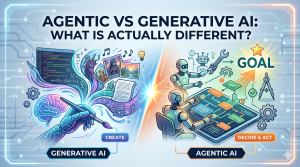
A: Traditional chatbots respond to individual prompts and reset with each interaction. Agentic AI systems are autonomous, goal-oriented, can take independent action, maintain memory across interactions, and execute complex multi-step processes. A chatbot might answer your question about order status; an agentic AI agent would autonomously monitor inventory, identify stockouts, coordinate with suppliers, and prevent customer issues before they occur.
Q: Do I need to replace my entire tech stack to use agentic AI?
A: No. One of agentic AI’s great strengths is that it can integrate with existing systems through APIs and connectors. Rather than replacing your ERP, CRM, or other software, agents work alongside them, automating workflows that connect these systems. That said, some legacy systems with poor API support may need modernization, and you’ll want a data infrastructure capable of feeding agents the information they need.
Q: What’s the biggest risk with deploying agentic AI?
A: Loss of control is the primary concern. As systems become more autonomous and capable, the potential for unintended consequences grows. An agent acting toward a goal without perfect alignment with your actual intentions could make decisions that technically achieve the goal but cause other problems. This is why governance, testing, and monitoring frameworks are so critical. Always deploy agents with clear boundaries, fallback mechanisms, and human oversight, especially when they control important business processes or customer interactions.
Q: Is agentic AI secure? Can it be hacked?
A: Agentic AI systems present both similar security challenges to traditional software and new unique risks. They can be hacked through compromised APIs, poisoned training data, or prompt injection attacks. Because they’re more autonomous, a successful attack could cause more damage. Security best practices include: limiting agent access to only necessary systems, encrypting communications, validating all inputs, monitoring agent behavior for anomalies, and maintaining human override capabilities. Security for agentic AI is an ongoing area of research and development.
“`