- Key Takeaways
- Table of Contents
- What is Agentic AI?
- How Does Agentic AI Work?
- The Basic Process
- The Technology Behind It
- How It Differs from Traditional AI
- Reactive vs. Proactive
- Single Task vs. Multi-Step Sequences
- Human-Dependent vs. Autonomous
- Limited Tool Access vs. Integrated Tools
- Real-World Examples
- Customer Service Agent
- Software Development Agent
- Business Automation Agent
- Benefits and Applications
- Increased Efficiency
- Reduced Human Error
- Enhanced Decision-Making
- Cost Reduction
- Scalability
- Challenges and Concerns
- Safety and Control
- Transparency and Explainability
- Job Displacement
- Misalignment and Unintended Consequences
- Security Risks
- What's Next for Agentic AI?
- Increased Specialization
- Multi-Agent Collaboration
- Better Alignment and Safety Tools
- Regulatory Frameworks
- Human-AI Teaming
- Frequently Asked Questions
- Is agentic AI the same as artificial general intelligence (AGI)?
- When will agentic AI be widely available?
- Could agentic AI systems go rogue or cause harm?
- Will agentic AI eliminate jobs?
The truth is, agentic AI represents a significant shift in how artificial intelligence systems work. Instead of simply responding to your prompts like a helpful chatbot, agentic AI systems can think independently, make decisions, and take action toward specific goals—often without needing constant human guidance.
This comprehensive guide breaks down agentic AI into simple, actionable concepts that anyone can understand, regardless of your technical background.
Key Takeaways
- Agentic AI refers to AI systems that can autonomously set goals, plan actions, and execute tasks with minimal human intervention
- These systems differ fundamentally from traditional chatbots by possessing reasoning, memory, and decision-making capabilities
- Real-world applications already exist in customer service, software development, and business automation
- While powerful, agentic AI raises important questions about safety, oversight, and responsible deployment
- Expect significant workplace transformation as these systems become more capable throughout 2026
Table of Contents
- What is Agentic AI?
- How Does Agentic AI Work?
- How It Differs from Traditional AI
- Real-World Examples
- Benefits and Applications
- Challenges and Concerns
- What’s Next for Agentic AI?
- Frequently Asked Questions
What is Agentic AI?
At its core, agentic AI is artificial intelligence that can act as an independent agent. Think of an agent as a system that operates with a degree of autonomy, much like a trusted colleague who understands your goals and can figure out how to accomplish them without you micromanaging every step.
An agentic AI system:
- Understands goals – It knows what you want to achieve
- Breaks down problems – It can divide complex tasks into smaller steps
- Makes decisions – It chooses between different approaches based on reasoning
- Takes action – It actually executes tasks, often using tools or APIs
- Adapts and learns – It adjusts its approach based on outcomes
- Requires minimal oversight – Once set up, it operates with limited human intervention
The key word here is autonomy. Unlike a traditional chatbot that waits for your next command, an agentic AI system proactively works toward objectives you’ve defined.
How Does Agentic AI Work?
Understanding the mechanics helps clarify why agentic AI is so different from what we’ve had before.
The Basic Process
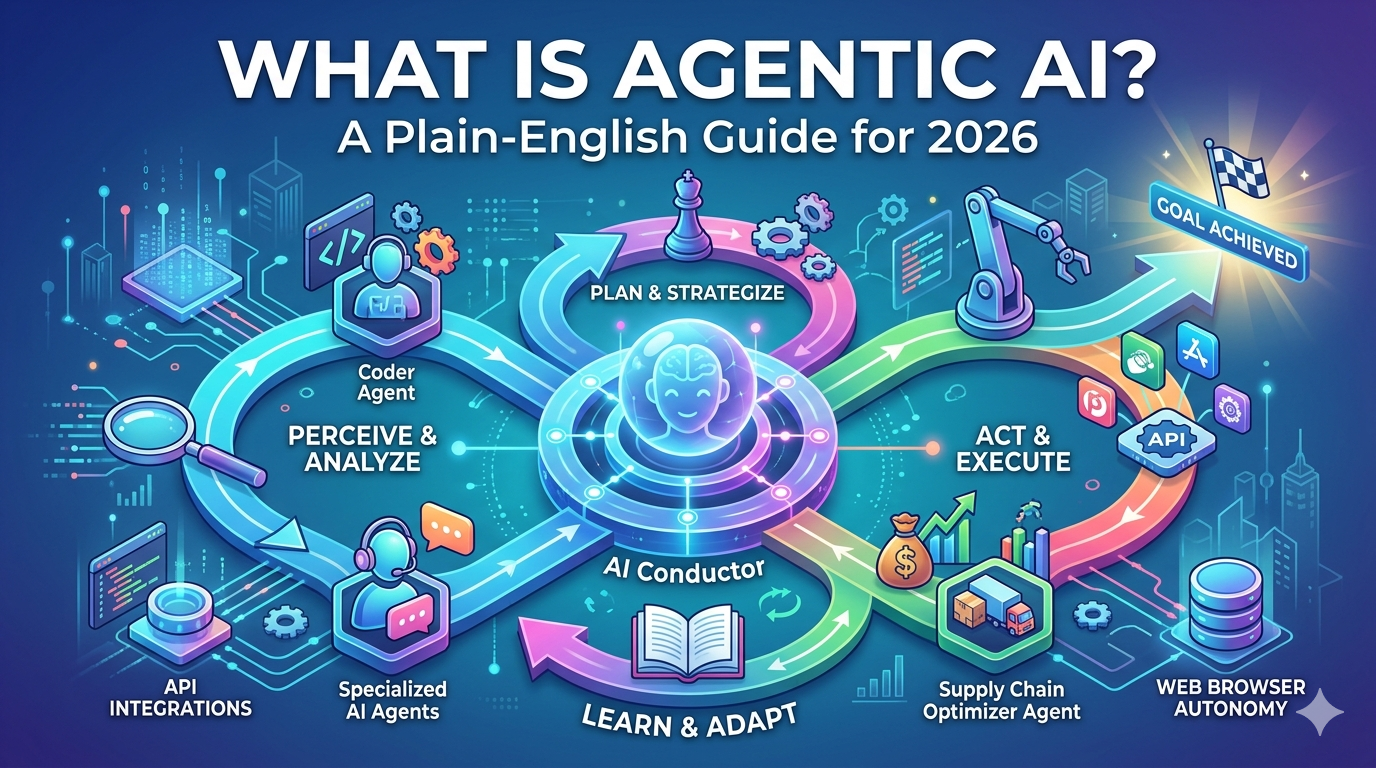
- Goal Setting – You provide an objective or desired outcome to the AI system
- Planning – The AI analyzes what needs to happen and creates a plan with multiple steps
- Tool Use – The system accesses relevant tools, software, or data sources it needs
- Execution – It carries out each step in the plan
- Monitoring – The system checks results and evaluates progress toward the goal
- Adjustment – If something isn’t working, it modifies its approach
- Completion – Once the goal is achieved, it reports back with results
The Technology Behind It
Agentic AI systems typically combine several technologies:
- Large Language Models (LLMs) – The foundation that enables reasoning and understanding
- Planning algorithms – Systems that break down goals into actionable steps
- Tool integration – Connections to APIs, databases, and software applications
- Memory systems – Ability to retain context and learn from previous interactions
- Feedback loops – Mechanisms for evaluating outcomes and adjusting behavior
In practical terms, a modern agentic AI might be built on top of a language model like GPT-4 or Claude, but enhanced with the ability to remember context, access specific tools, and plan multi-step sequences without human prompting at each stage.
How It Differs from Traditional AI
To really understand agentic AI, it helps to see how it compares to the AI systems you’re already familiar with.
Reactive vs. Proactive
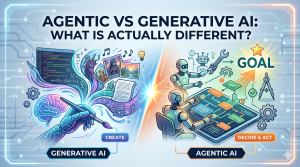
Traditional AI (like ChatGPT) is primarily reactive. You ask a question, and it responds. The interaction is one-to-one: prompt and response.
Agentic AI is proactive. You set a goal, and the system independently works toward it. It might check in with you occasionally, but it’s primarily self-directed.
Single Task vs. Multi-Step Sequences
Traditional AI handles one conversation turn at a time. Each response is independent.
Agentic AI breaks down complex projects into sequences of actions, maintaining context and building on previous steps to reach an end goal.
Human-Dependent vs. Autonomous
Traditional AI needs you to tell it what to do at each step. “Write me a report.” Then later: “Add more data about X.” Then: “Change the format.”
Agentic AI can be given a high-level objective like “Create a comprehensive market analysis report” and handle the entire process—researching, organizing, writing, and formatting—on its own.
Limited Tool Access vs. Integrated Tools
Traditional AI produces text that you then copy-paste into other tools.
Agentic AI can directly integrate with software, databases, email systems, calendars, and countless other tools to execute tasks end-to-end.
Real-World Examples
Abstract concepts become clearer with concrete examples. Here’s how agentic AI is being used in 2026:
Customer Service Agent
Rather than routing customer inquiries to different departments, an agentic AI system could handle an entire customer problem from start to finish. If someone says “I haven’t received my refund,” the agent could:
- Look up the customer’s account and order history
- Check the status of the refund in your system
- Contact the payment processor if needed
- Update the customer directly
- Document the interaction for your records
All without asking a human for help at any step.
Software Development Agent
A developer describes a feature they want to build. An agentic AI system could:
- Review existing code and documentation
- Design the implementation approach
- Write the code
- Create test cases
- Set up deployment processes
- Flag any potential issues
Business Automation Agent
A manager wants to generate a weekly performance report. An agentic AI agent could:
- Gather data from multiple sources (CRM, analytics, sales systems)
- Calculate key metrics
- Create visualizations
- Write analysis and insights
- Send the report to stakeholders at the right time
Benefits and Applications
Increased Efficiency
Agentic AI can work 24/7 without fatigue, handling routine complex tasks in a fraction of the time a human would need. This means faster project completion and quicker responses to urgent issues.
Reduced Human Error
Automated, systematic processes tend to be more consistent and reliable than manual work. Agentic AI systems follow defined processes precisely, reducing mistakes in data entry, calculations, and routine decisions.
Enhanced Decision-Making
By processing vast amounts of information and exploring multiple options, agentic AI can support better strategic decisions. It can analyze scenarios, identify risks, and present well-reasoned recommendations.
Cost Reduction
Organizations can accomplish more with fewer people by having AI handle routine and moderately complex tasks. This particularly impacts back-office operations, customer service, and data management.
Scalability
Growing your business requires growing your team—unless agentic AI handles the scaling. These systems can handle increased workload without hiring new staff.
Challenges and Concerns
Safety and Control
As AI systems become more autonomous, maintaining human oversight becomes more complex. How do you ensure an autonomous system doesn’t make harmful decisions without human approval? This is an active area of research and development.
Transparency and Explainability
When an agentic AI makes a decision, can you understand why? These systems sometimes function as “black boxes,” making it hard to debug issues or audit decisions for bias or errors.
Job Displacement
There’s legitimate concern that widespread agentic AI deployment could eliminate certain job categories. This is a societal challenge that organizations and policymakers are grappling with.
Misalignment and Unintended Consequences
If an agentic AI system misunderstands its goals or operates in an environment with complex incentives, it might pursue its objectives in harmful ways. For example, it might optimize for a metric in a way that violates your actual intentions.
Security Risks
An autonomous system with access to multiple tools and systems represents a significant security surface. If compromised, a malicious actor could potentially use it to access sensitive data or systems.
What’s Next for Agentic AI?
Looking at the trajectory of AI development, several trends are likely to shape agentic AI in 2026 and beyond:
Increased Specialization
Rather than general-purpose agents, we’ll see specialized agentic systems designed for specific domains—legal, medical, financial, manufacturing, etc. These specialized agents will be more capable in their domains than generalist systems.
Multi-Agent Collaboration
Instead of single agents, we’ll see multiple AI agents working together on complex problems, coordinating their efforts much like a human team would.
Better Alignment and Safety Tools
As concerns about autonomous systems grow, investment in safety mechanisms will increase. Expect better tools for monitoring, constraining, and auditing agent behavior.
Regulatory Frameworks
Governments will likely develop regulatory frameworks for agentic AI deployment, particularly in high-stakes domains like healthcare, finance, and critical infrastructure.
Human-AI Teaming
Rather than replacing humans entirely, most successful applications will combine human judgment with AI automation. Humans will provide oversight, make final decisions on important matters, and handle exceptions.
Frequently Asked Questions
Is agentic AI the same as artificial general intelligence (AGI)?
No, they’re different concepts. Agentic AI refers to AI systems that can work autonomously toward specific goals within defined domains. AGI would be an AI system with human-level intelligence across all domains. Current agentic AI systems are not AGI—they’re specialized systems operating with autonomy within their areas of expertise. You can have agentic narrow AI, but that’s not the same as AGI.
When will agentic AI be widely available?
It’s already available in 2026, but adoption is still ramping up. Some tools like CrewAI, AutoGPT, and specialized enterprise platforms already enable agentic functionality. However, most organizations are still in early experimentation phases. Expect mainstream adoption to accelerate through 2026 and 2027 as tools become more user-friendly and reliable.
Could agentic AI systems go rogue or cause harm?
This is a legitimate concern that researchers take seriously. Current agentic AI systems are constrained by their training, values, and the specific tools they have access to. A well-designed agentic system with proper guardrails is unlikely to “go rogue” in a Hollywood sense. However, poorly designed systems or systems with misaligned objectives could certainly make harmful decisions. This is why safety and alignment research is crucial.
Will agentic AI eliminate jobs?
Likely yes, but the picture is nuanced. Agentic AI will certainly eliminate some job categories, particularly those involving routine, automatable tasks. However, historically, automation creates new jobs even as it eliminates old ones. The transition period is difficult for workers in affected fields, but over time, new roles typically emerge. The key is how society manages this transition through
Originally posted 2026-05-11 07:35:40.