- Key Takeaways
- Table of Contents
- Understanding Generative AI
- How Generative AI Works
- What is Agentic AI?
- Key Components of Agentic AI
- Core Differences Between Agentic and Generative AI
- Autonomy and Initiative
- Task Complexity and Duration
- Decision-Making Authority
- Environmental Interaction
- Practical Examples and Real-World Applications
- Generative AI in Practice
- Agentic AI in Practice
- Autonomy and Decision-Making Capabilities
- The Autonomy Spectrum
- Guardrails and Safety
- Future Implications and Industry Impact
- Impact on Workforce and Skills
- Industry-Specific Transformations
Key Takeaways
- Generative AI creates new content based on prompts and learned patterns from training data
- Agentic AI takes autonomous action, makes decisions, and completes multi-step tasks without constant human guidance
- Generative AI responds to queries; agentic AI initiates and plans independently
- The key difference lies in autonomy, decision-making capability, and the ability to break down complex goals into executable steps
- Both technologies are advancing rapidly, with agentic AI representing the next frontier in artificial intelligence
Table of Contents
- Understanding Generative AI
- What is Agentic AI?
- Core Differences Between Agentic and Generative AI
- Practical Examples and Real-World Applications
- Autonomy and Decision-Making Capabilities
- Future Implications and Industry Impact
- Frequently Asked Questions
- About the Author
Understanding Generative AI
Generative AI has captured the world’s attention in recent years, particularly with the rise of large language models like ChatGPT, Claude, and others. At its core, generative AI is a system trained on vast amounts of data that can generate new content in response to user prompts. This content can be text, images, code, music, or video.
The fundamental mechanism behind generative AI involves learning patterns from training data and then using those patterns to create novel outputs that resemble the training data. When you ask ChatGPT to write an essay or an image generator to create a picture based on a description, you’re experiencing generative AI in action.
How Generative AI Works
Generative AI systems operate on a relatively straightforward principle:
- Input Processing: The system receives a prompt or query from a user
- Pattern Matching: It identifies relevant patterns from its training data that match the request
- Content Generation: The model generates new content based on those patterns and learned relationships
- Output Delivery: The generated content is presented to the user
This process happens within a single interaction or conversation turn. The AI responds to what you ask but doesn’t independently plan to accomplish goals or take actions beyond generating the requested content.
What is Agentic AI?
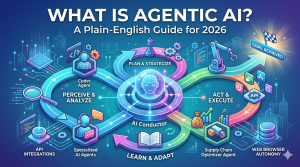
Agentic AI represents a more advanced form of artificial intelligence where systems can autonomously perceive their environment, make decisions, and take actions toward specific goals without requiring constant human intervention. Unlike generative AI, which responds to prompts, agentic AI proactively works toward objectives.
An agentic AI system might be tasked with “optimize our marketing campaign for Q4,” and without further instruction, it would plan the necessary steps, gather relevant data, make decisions about strategy adjustments, implement changes, monitor results, and adjust tactics as needed. This represents a fundamentally different level of capability and autonomy.
Key Components of Agentic AI
Agentic AI systems typically include several critical components that distinguish them from simple generative models:
- Goal Setting and Planning: The ability to understand objectives and create multi-step plans to achieve them
- Tool Integration: Access to and ability to use various tools, APIs, and external systems to accomplish tasks
- Decision-Making: Autonomous choice-making based on available information and defined parameters
- Learning and Adaptation: Ability to learn from outcomes and adjust strategies accordingly
- Monitoring and Feedback: Continuous assessment of progress toward goals and environmental changes
Core Differences Between Agentic and Generative AI
While agentic AI may use generative AI capabilities as one of its components, the differences between these two categories are profound and important to understand.
Autonomy and Initiative
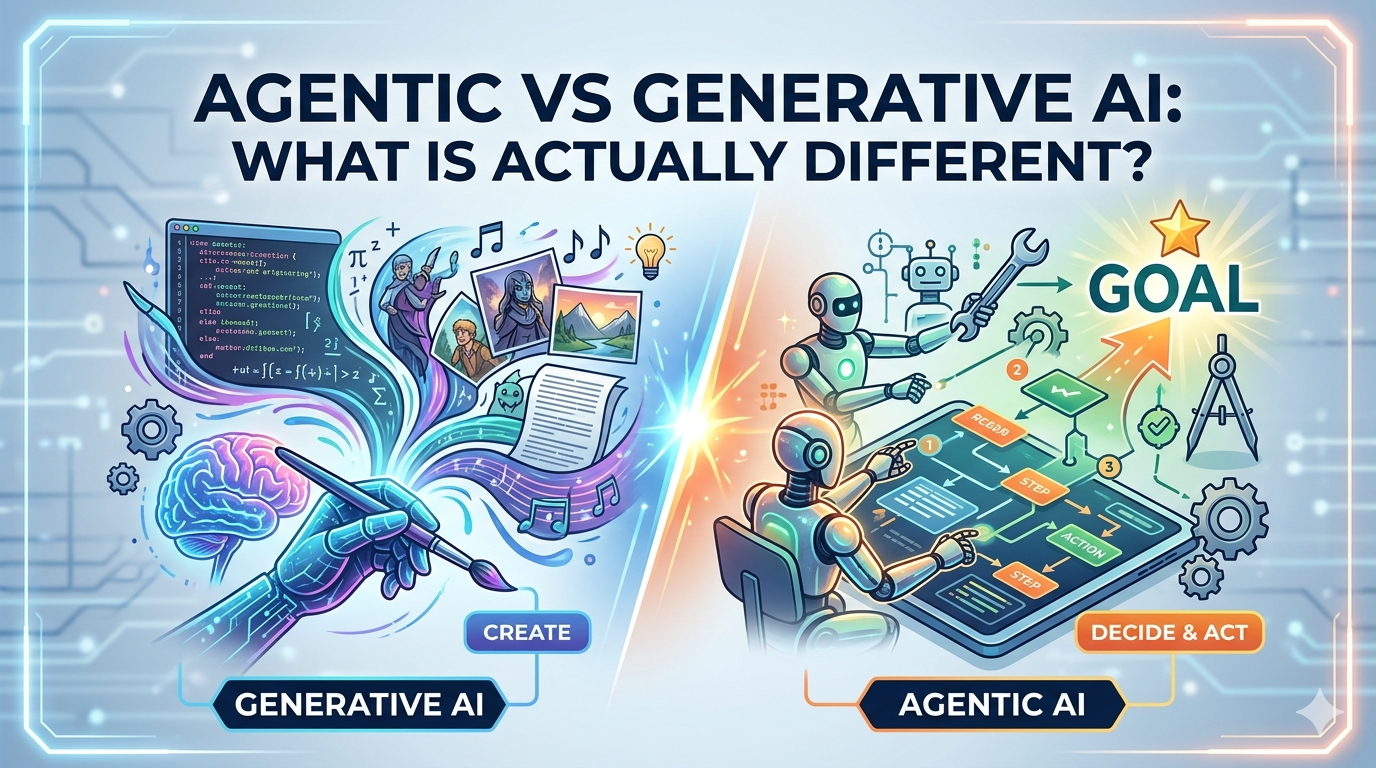
Generative AI is fundamentally reactive. It waits for user input and generates responses based on that input. You control the conversation and direct what gets created. Agentic AI is proactive. It can identify what needs to be done, prioritize tasks, and take action without waiting for specific instructions at each step.
Task Complexity and Duration
Generative AI excels at single-turn or short-conversation tasks. You ask a question, it provides an answer. That’s the complete interaction. Agentic AI, by contrast, handles complex, multi-step projects that unfold over extended periods. It can break down a large goal into smaller tasks, execute them sequentially, handle dependencies, and adjust plans based on intermediate results.
Decision-Making Authority
With generative AI, humans must interpret outputs and decide what to do with them. The AI generates options or information, but a human ultimately makes decisions about implementation. Agentic AI has authority to make decisions within defined parameters. It can approve actions, modify strategies, and implement changes autonomously.
Environmental Interaction
Generative AI operates in isolation. It doesn’t access real-time data, interact with external systems, or change anything about your actual business or processes beyond generating content. Agentic AI directly interacts with your environment. It accesses databases, runs simulations, modifies documents, adjusts settings, and creates measurable changes in your systems.
| Characteristic | Generative AI | Agentic AI |
|---|---|---|
| Initiative | Reactive; responds to prompts | Proactive; pursues goals autonomously |
| Task Scope | Single-turn or short conversations | Multi-step, long-duration projects |
| Decision-Making | Generates information; humans decide | Autonomous decision-making within parameters |
| Tool Integration | Limited; mainly generates text/content | Extensive; accesses and controls external systems |
| Environmental Impact | Generates content only; doesn’t change systems | Directly modifies and impacts systems |
| Feedback Loop | Limited; relies on human guidance | Continuous monitoring and self-adjustment |
Practical Examples and Real-World Applications
Generative AI in Practice
Consider these practical applications of generative AI:
- Content Writing: A marketing team uses ChatGPT to draft blog post outlines, social media captions, and email copy. Humans review and refine the generated content before publication.
- Code Generation: A developer uses GitHub Copilot to generate code snippets based on function descriptions. The developer reviews the code and integrates it into their project.
- Image Creation: A designer uses DALL-E to generate initial design concepts for client approval. The designer then refines the selected concept manually.
- Data Summarization: An analyst feeds a generative AI system hundreds of pages of research and asks it to create a summary. The analyst reviews the summary for accuracy.
In all these cases, humans remain in control of the decision-making process. The AI generates options or content, but people decide what to do with those outputs.
Agentic AI in Practice
Agentic AI applications look fundamentally different:
- Autonomous Research: An agentic system is tasked with analyzing competitor pricing strategies. It automatically accesses public data, compares pricing across markets, identifies trends, and generates a strategic report without human intervention at each step.
- Customer Service: An agentic AI system handles complex customer issues by autonomously gathering information from multiple databases, researching relevant policies, making decisions about solutions, and even executing refunds or account modifications as appropriate.
- Portfolio Management: An agentic system monitors investment portfolios, analyzes market conditions, makes buy and sell decisions within predefined risk parameters, executes trades, and adjusts allocations based on real-time data.
- IT Operations: An agentic system monitors infrastructure, identifies problems, diagnoses root causes, implements fixes (like restarting services or scaling resources), and notifies humans only when issues exceed its handling parameters.
Autonomy and Decision-Making Capabilities
The distinction between autonomy in generative versus agentic AI deserves deeper exploration because it’s the fundamental differentiator.
The Autonomy Spectrum
Think of AI capabilities as existing on a spectrum of autonomy:
- Level 1 – No Autonomy: Traditional software that follows strictly defined rules with no adaptability
- Level 2 – Limited Autonomy: Generative AI that creates content but requires human interpretation and decision-making
- Level 3 – Moderate Autonomy: Systems that can make decisions within narrow, well-defined parameters
- Level 4 – High Autonomy: Agentic AI that can pursue complex goals with minimal human intervention
- Level 5 – Full Autonomy: Theoretical systems with unrestricted decision-making authority (not currently realized)
Today’s generative AI operates at Level 2, while emerging agentic AI systems are reaching Level 3-4. The critical difference is that agentic systems can pursue goals independently, making necessary decisions and adjustments along the way, while generative systems require humans to direct each step.
Guardrails and Safety
As agentic AI becomes more autonomous, safety mechanisms become essential. Responsible agentic AI systems include:
- Defined Boundaries: Clear parameters about what actions the system can and cannot take
- Approval Workflows: For high-impact decisions, systems may require human approval before implementation
- Audit Trails: Complete logging of all decisions and actions for transparency and accountability
- Escalation Protocols: Automatic escalation to humans when situations exceed the system’s defined scope
Future Implications and Industry Impact
Understanding the difference between agentic and generative AI is crucial because the business world is rapidly moving toward agentic applications, and this shift will reshape how work gets done.
Impact on Workforce and Skills
Generative AI has already changed how people work. Professionals now use ChatGPT, Copilot, and similar tools to accelerate routine tasks. Agentic AI will take this further by automating not just task components but entire workflows. The impact on employment will be more significant and require different skill sets. Rather than being displaced entirely, workers will transition to supervisory and strategic roles, focusing on setting goals, monitoring agent performance, and handling exceptions.
Industry-Specific Transformations
Different industries will experience different impacts from agentic AI adoption:
- Financial Services: Autonomous trading, risk assessment, and compliance monitoring will accelerate significantly
Originally posted 2026-05-10 07:36:23.