- Table of Contents
- Key Takeaways
- Understanding the Difference
- 1. Independent Decision-Making and Planning
- What Generative AI Does
- What Agentic AI Does
- 2. Multi-Step Task Execution Without Human Intervention
- 3. Real-Time Environmental Interaction
- Environmental Interaction Capabilities
- 4. Continuous Learning and Adaptation
- Learning Differences
- 5. Goal-Oriented Problem Solving
- Goal-Oriented Capabilities
- Implications for Business and Technology
- Business Applications
- Development Considerations
- Frequently Asked Questions
- Can generative AI be made to act like agentic AI with better prompting?
“`html
5 Things Agentic AI Can Do That Generative AI Cannot
Artificial intelligence has evolved dramatically over the past few years, and the landscape is becoming increasingly nuanced. While generative AI has captured headlines with its impressive text, image, and code generation capabilities, a new paradigm is emerging: agentic AI. These autonomous systems represent a fundamental shift in how we think about AI capabilities and their real-world applications.
If you’ve been following AI developments, you’ve likely heard these terms used interchangeably, but they’re fundamentally different. Understanding these differences is crucial for businesses, developers, and anyone interested in the future of artificial intelligence. This article explores five critical capabilities that set agentic AI apart from traditional generative AI.
Table of Contents
- Understanding the Difference
- 1. Independent Decision-Making and Planning
- 2. Multi-Step Task Execution Without Human Intervention
- 3. Real-Time Environmental Interaction
- 4. Continuous Learning and Adaptation
- 5. Goal-Oriented Problem Solving
- Implications for Business and Technology
- Frequently Asked Questions
Key Takeaways
- Agentic AI operates autonomously to achieve specific goals, while generative AI primarily responds to prompts with generated content
- Agentic AI can make decisions and execute multi-step plans without requiring human approval at each stage
- These systems can interact with real-world environments, APIs, and systems in real-time
- Agentic AI learns and adapts from experiences rather than remaining static
- The ability to break down complex problems and work toward predefined goals is fundamental to agentic systems
Understanding the Difference
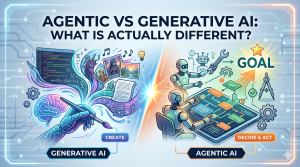
Before diving into specific capabilities, it’s important to establish a clear understanding of what distinguishes agentic AI from generative AI. Generative AI systems like ChatGPT, Claude, or DALL-E are fundamentally reactive. They process input (a prompt or query) and generate output based on patterns learned during training. They don’t have goals, and they don’t take independent action.
Conversely, agentic AI represents a proactive approach. These systems are designed with specific objectives, operate with autonomy, and can take actions independently to achieve their goals. Think of it this way: generative AI is like a knowledgeable colleague who answers your questions, while agentic AI is like an employee who understands their role and accomplishes tasks without needing detailed instructions for every step.
1. Independent Decision-Making and Planning
Perhaps the most significant distinction is that agentic AI systems can make decisions independently based on their objectives and the current context. This goes far beyond the pattern-matching that generative AI performs.
What Generative AI Does
- Analyzes a prompt and generates a response based on learned patterns
- Provides information or content when requested
- Cannot decide when to take action or what goals to pursue
- Requires human input to determine next steps
What Agentic AI Does
- Evaluates situations and makes decisions aligned with predefined objectives
- Creates multi-step plans to achieve goals
- Prioritizes tasks based on importance and feasibility
- Adjusts strategies based on feedback and changing circumstances
For example, imagine you’re running a customer service operation. A generative AI chatbot can answer questions when customers ask them. An agentic AI system, however, could proactively identify dissatisfied customers from support ticket patterns, prioritize responses, route issues to appropriate departments, and follow up without human intervention.
2. Multi-Step Task Execution Without Human Intervention
Agentic AI excels at executing complex, multi-step workflows autonomously. This is a capability that generative AI simply cannot match in the same way.
Generative AI’s workflow typically looks like this:
- User provides input → System generates output → User evaluates and decides next step → Process repeats
Agentic AI’s workflow operates differently:
- Define goal → Agent creates plan → Executes steps → Monitors progress → Adjusts as needed → Reports results
This means agentic systems can handle scenarios involving dozens of interconnected actions across multiple systems. A concrete example: an agentic AI could be tasked with “optimize our marketing budget across channels.” It could simultaneously analyze campaign performance, retrieve market data, consult competitor strategies, calculate ROI projections, execute budget reallocations, and monitor results—all without human oversight at intermediate steps.
3. Real-Time Environmental Interaction
Another critical difference is that agentic AI can interact directly with its environment—whether that’s software systems, APIs, sensors, or physical devices. Generative AI doesn’t naturally do this.
Environmental Interaction Capabilities
- API Integration: Agentic systems can call APIs to fetch real-time data, update databases, or trigger actions in connected systems
- Continuous Monitoring: These systems can observe environmental changes and respond accordingly without waiting for human prompts
- Tool Usage: Agentic AI can operate software tools, access files, manipulate databases, and execute code dynamically
- Hardware Control: In advanced implementations, agentic systems can interact with robotic systems, IoT devices, and automated equipment
Consider a supply chain management scenario. A generative AI could tell you what supply chain optimization strategies exist if you ask. An agentic AI could monitor inventory across multiple warehouses in real-time, predict shortages using market data, automatically place orders with suppliers, adjust logistics routes, and optimize delivery schedules—all while actively connected to your business systems.
4. Continuous Learning and Adaptation
While some might argue that generative models learn during training, they are static once deployed. Agentic AI systems, by contrast, can learn and adapt from experience in real-time or near real-time.
Learning Differences
- Generative AI: Static knowledge from training data; cannot learn from new interactions
- Agentic AI: Updates strategies based on outcomes; learns what works in their specific environment
An agentic AI managing customer support could recognize patterns in successful resolution strategies and increasingly deploy those approaches. It might discover that certain question phrasings correlate with customer satisfaction and adjust its communication style accordingly. It learns not just abstract facts but contextual wisdom about its specific operational environment.
5. Goal-Oriented Problem Solving
Perhaps the defining characteristic of agentic AI is that it operates with explicit goals and measures of success. Generative AI has no goal beyond generating a response to input.
Goal-Oriented Capabilities
- Objective Definition: Agentic systems understand what success looks like and maintain focus on achieving it
- Constraint Awareness: They recognize limitations (time, budget, resources) and optimize within those boundaries
- Trade-off Navigation: When facing competing objectives, agentic systems can weigh options and make principled decisions
- Outcome Measurement: These systems can evaluate their progress toward goals and adjust tactics accordingly
Imagine an agentic AI tasked with “reduce customer churn while maintaining profit margins.” It must navigate the tension between these goals—investing in retention while controlling costs. It would analyze which customers are at highest risk, determine optimal retention strategies for each segment, calculate cost-benefit tradeoffs, and deploy solutions while continuously monitoring impact on both churn and profitability.
Implications for Business and Technology
The emergence of agentic AI has profound implications for how organizations approach automation and AI deployment. Rather than using AI primarily for content creation or information retrieval, forward-thinking companies are beginning to deploy agentic systems for complex operational challenges.
Business Applications
- Operations Management: Autonomous systems managing workflows, resource allocation, and optimization
- Sales and Marketing: Agents that identify prospects, personalize outreach, and manage campaigns end-to-end
- Financial Management: Autonomous systems managing investments, expense tracking, and financial forecasting
- HR and Recruitment: Agents screening candidates, scheduling interviews, and managing onboarding processes
Development Considerations
Organizations planning to implement agentic AI systems need to consider several factors: safety guardrails become more critical when systems operate autonomously, clear objective definition is essential to prevent unintended consequences, monitoring and oversight remains important even for autonomous systems, and transparency in decision-making helps maintain trust.
Frequently Asked Questions
Can generative AI be made to act like agentic AI with better prompting?
While sophisticated prompting can make generative AI behave more systematically, it remains fundamentally reactive. You must provide input for each step, and the system cannot truly learn from outcomes or operate independently toward goals. Agentic AI represents a different architectural approach, not just better prompting of generative systems.