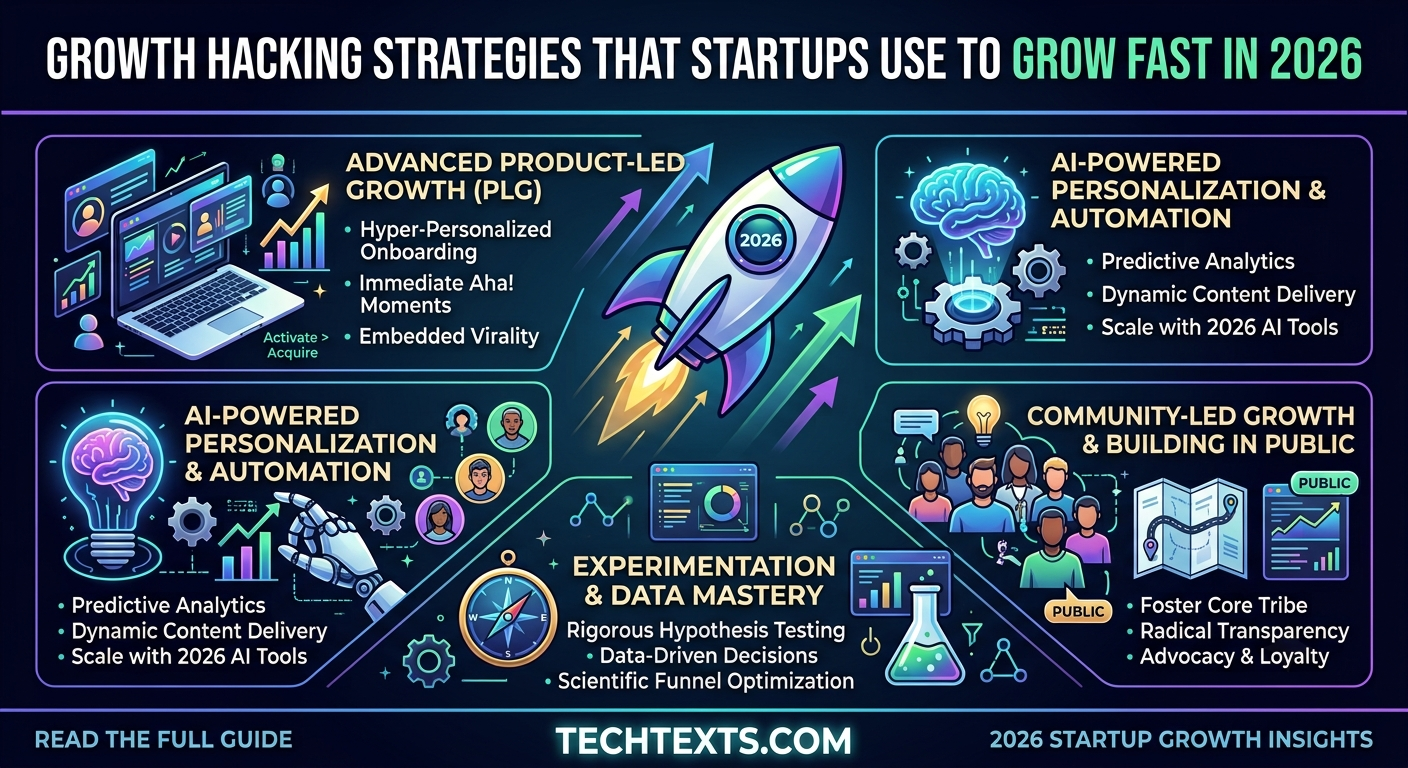
- Key Takeaways
- What Is Growth Hacking?
- The AAARRR Framework: A Foundation for Growth Thinking
- 1. Nail Product-Market Fit First
- How to Identify Product-Market Fit
- Signs You Don't Have Product-Market Fit Yet
- 2. Build Viral Loops Into Your Product
- Types of Viral Loops
- Calculating and Improving Your Viral Coefficient
- 3. Leverage Content Marketing at Scale
- Content Strategies That Drive Growth
- Scaling Content Without Sacrificing Quality
- 4. Create Strategic Partnerships and Integrations
- Partnership Models That Work
- Choosing the Right Partners
- 5. Use Data Analytics for Decision Making
- Essential Metrics to Track
- Growth Analytics Tools
- A/B Testing Discipline
- 6. Build a Strong Community
- Community-Building Tactics
- 7. Design for Product-Led Growth
- Core PLG Mechanics
- 8. Use AI to Accelerate Every Growth Lever
- Common Growth Hacking Mistakes to Avoid
- Building Your Growth Hacking Roadmap
- Frequently Asked Questions
- Q: How long does it take to achieve product-market fit?
- Q: What's the difference between growth hacking and traditional marketing?
- Q: Do I need a dedicated "growth team" to do growth hacking?
- Q: What's the single biggest growth hacking mistake startups make?
- Q: How much should a startup budget for growth hacking experiments?
- Conclusion
Key Takeaways
- Product-market fit comes first: Before aggressive growth tactics, ensure your product solves a real problem for your target audience.
- Data-driven decisions: Modern growth hackers rely on analytics and A/B testing rather than intuition alone.
- Viral loops and referrals: Building referral mechanics into your product creates exponential growth potential.
- Community building: Engaged communities around your brand provide sustainable, long-term growth.
- Omnichannel approach: The most successful startups combine multiple channels — content, paid ads, partnerships, and social media.
- AI-native growth: In 2026, the fastest-growing startups increasingly build AI directly into their acquisition, activation, and retention loops, not just their product.
What Is Growth Hacking?
Growth hacking is a methodology that prioritizes rapid experimentation across product development, marketing, and data analytics to achieve sustainable, scalable growth. Unlike traditional marketing that focuses on brand building and awareness, growth hacking is laser-focused on measurable results and customer acquisition.
The term gained prominence during the early 2010s when startups like Airbnb, Dropbox, and Slack achieved explosive growth with minimal budgets. Today in 2026, growth hacking remains the cornerstone strategy for ambitious startups competing in crowded markets — though the toolkit has evolved considerably, with AI-powered experimentation, synthetic user research, and automated personalization now standard parts of the growth playbook rather than novelties.
What hasn’t changed is the underlying philosophy: growth hacking treats marketing as a series of testable hypotheses rather than a fixed campaign calendar. A growth hacker asks “what’s the cheapest, fastest way to validate whether this works?” before committing significant budget to any single channel.
The AAARRR Framework: A Foundation for Growth Thinking
Before diving into individual tactics, it helps to have a mental model for where each tactic actually applies. Most growth teams organize their thinking around a funnel often called “Pirate Metrics” (AAARRR), because reading it aloud sounds like a pirate’s “arrr”:
- Awareness — How do potential customers first learn you exist?
- Acquisition — How do they land on your product or website?
- Activation — Do they experience your product’s core value quickly enough to stick around?
- Retention — Do they come back and keep using it?
- Revenue — Do they pay, and how much?
- Referral — Do they tell others?
The tactics in this guide map onto different stages of this funnel. Content marketing and partnerships tend to drive awareness and acquisition. Viral loops drive referral. Data analytics and community-building span the entire funnel. Keeping this framework in mind helps you diagnose where your growth is actually stuck, rather than throwing generic tactics at a problem that might be happening at a completely different stage.
1. Nail Product-Market Fit First
Before implementing any growth strategy, you must achieve product-market fit — the stage where your product satisfies a strong market demand. This is non-negotiable, and it’s the single most common reason growth tactics fail: no amount of viral mechanics or paid acquisition can compensate for a product people don’t actually want.
How to Identify Product-Market Fit
- Customer retention rates: Aim for at least 25–30% monthly retention for consumer products, or 90%+ for B2B products.
- Net Promoter Score (NPS): Scores above 50 indicate strong product-market fit.
- Organic word-of-mouth: Users recommend your product without incentives.
- Customer feedback: Users can articulate the core value of your product clearly, often in their own words rather than echoing your marketing copy.
- The “very disappointed” test: A widely used survival test asks users how they’d feel if they could no longer use your product. If 40% or more say “very disappointed,” that’s historically been a strong signal of genuine product-market fit.
Slack famously grew to 500,000 daily active users by 2015 because it solved a genuine problem in team communication. The product was so good that teams naturally shared it with other teams, creating organic growth before any major marketing push. This pattern — organic pull preceding paid push — shows up repeatedly among startups that scale efficiently, and its absence is usually a red flag that a team is trying to force growth prematurely.
Signs You Don’t Have Product-Market Fit Yet
- Growth relies almost entirely on paid acquisition, and stops the moment ad spend pauses.
- Customer feedback is polite but vague — people like the idea but don’t use it consistently.
- Retention curves never flatten; users keep churning at a steady rate no matter how long they’ve been signed up.
- Your team spends more time explaining the product than users spend using it.
If you recognize these signs, the right move is almost always to pause aggressive growth spending and go back to customer interviews and product iteration. Scaling a leaky bucket only makes the leak bigger.
2. Build Viral Loops Into Your Product
A viral loop is a mechanism within your product that encourages users to invite others. Dropbox, for example, offered free storage (2.5GB) to users who referred friends. This simple referral system drove their growth to 4 million users by 2012.
Types of Viral Loops
- Incentivized referrals: Reward users for inviting friends (Dropbox model).
- Network effects: Product becomes more valuable as more people join (LinkedIn, Slack).
- Viral content: Users naturally share content created within your app (TikTok, Instagram Reels).
- Social sharing: Built-in sharing buttons that make it easy to tell others (Pinterest).
- Collaborative use cases: Products that require multiple people to function fully — like shared documents, project boards, or group chats — build virality directly into the core use case rather than as a bolted-on referral program.
Calculating and Improving Your Viral Coefficient
To calculate your viral coefficient (often called the “K-factor”), track how many new users each existing user brings, multiplied by the conversion rate of those invitations. A coefficient above 1.0 means exponential growth — each user brings in more than one additional user on average, and the loop compounds on itself. Most successful startups target 0.2 to 0.7, which still produces significant compounding growth over time when combined with steady top-of-funnel acquisition from other channels.
Improving your viral coefficient usually comes down to two levers: increasing the number of invitations each user sends, and increasing the percentage of invitations that convert. Reducing friction in the invitation flow — pre-filled messages, one-tap sharing, clear incentives — tends to move both numbers simultaneously.
3. Leverage Content Marketing at Scale
Content marketing has evolved well beyond blog posts. In 2026, successful startups use multiple content formats to capture market share across different stages of the customer journey, and increasingly use AI-assisted workflows to produce and distribute that content faster than manual processes ever allowed.
Content Strategies That Drive Growth
- SEO-optimized blog content: Target high-intent keywords to attract organic traffic. Companies that prioritize blogging have historically seen dramatically higher marketing ROI than those that don’t, according to HubSpot’s inbound marketing research.
- Video tutorials and demos: Platforms like YouTube and TikTok provide massive reach. Tools like Loom and Wistia dominate their categories partly through excellent product demo videos.
- Educational courses: Build authority and capture leads. Course creators on platforms like Teachable and Kajabi often cross-promote with complementary products.
- Podcasts and audio content: Build deeper audience connections. Podcast listeners tend to be highly engaged and loyal compared to other content formats.
- Community-generated content: User reviews, testimonials, and case studies provide authentic social proof that converts better than brand-produced marketing copy.
- Interactive and AI-assisted content: Calculators, quizzes, and AI-powered chat tools embedded directly in content pages increasingly capture leads more effectively than static text, since they give visitors an immediate, personalized reason to engage.
Scaling Content Without Sacrificing Quality
The temptation with content marketing in 2026 is to use AI tools to produce enormous volumes of content quickly. This can work, but it carries real risk: search engines have become significantly better at identifying and deprioritizing low-value, mass-produced content, and readers are quick to bounce from generic material that doesn’t demonstrate genuine expertise. The startups that succeed with content at scale typically combine AI-assisted drafting with human editorial oversight, original data or case studies, and a genuine point of view — rather than relying on AI output alone.
4. Create Strategic Partnerships and Integrations
Growth through partnerships can be faster than organic channels. By aligning with complementary businesses, you gain access to their audience and credibility without having to build that trust from scratch.
Partnership Models That Work
- Co-marketing campaigns: Two complementary brands promote each other’s products to their respective audiences.
- API integrations: Make your product more valuable by connecting with existing tools — Slack’s app ecosystem, with thousands of integrations, is a well-known example of this compounding effect.
- Revenue sharing: Partner platforms handle distribution while you provide the product.
- Strategic acquisitions: For mature startups, acquiring complementary products can instantly boost growth — Facebook’s acquisition of Instagram remains a widely cited example.
- Affiliate programs: Incentivize partners to promote your product on commission.
Zapier experienced explosive growth by building integrations with hundreds of apps. By becoming the “glue” between tools, they created a defensible moat that’s difficult for competitors to replicate, since each new integration adds switching costs and makes the platform more valuable to existing users.
Choosing the Right Partners
Not every partnership is worth pursuing. The most effective partnerships share three characteristics: audience overlap (the partner’s users are plausible customers for you), complementary rather than competitive positioning (you solve a different piece of the same problem), and mutual incentive (the partnership genuinely benefits both parties, not just you). Partnerships that fail this test tend to fizzle quickly, since the partner has little reason to actively promote the relationship.
5. Use Data Analytics for Decision Making
Growth hacking without data is just guessing. The most successful startups treat data as their competitive advantage, building measurement into every experiment from the outset rather than trying to reconstruct what happened after the fact.
Essential Metrics to Track
- Customer Acquisition Cost (CAC): How much you spend to acquire one customer.
- Lifetime Value (LTV): Total revenue a customer generates over their lifetime.
- LTV:CAC ratio: Aim for at least 3:1 for sustainable growth.
- Churn rate: Percentage of users who stop using your product.
- Activation rate: Percentage of new users who reach the “aha moment” — the point where they first experience your product’s core value.
- Conversion funnel: Track where users drop off in your sales process, stage by stage.
- Payback period: How many months it takes to recoup your CAC — shorter payback periods let you reinvest in growth faster.
Growth Analytics Tools
Modern startups use sophisticated analytics platforms including:
- Google Analytics 4: Free website and app analytics with event-based tracking.
- Amplitude: Product analytics for tracking user behavior and cohort analysis.
- Mixpanel: Event-based analytics for detailed user journey mapping and funnel analysis.
- Segment: Data collection and integration platform that routes data to hundreds of downstream tools.
- Tableau and Looker: Data visualization and business intelligence for turning raw metrics into decisions.
A/B Testing Discipline
A/B testing is non-negotiable. Netflix’s recommendation algorithm and Airbnb’s photo optimization both started as simple A/B tests that compounded to massive impact over time. The discipline here matters as much as the tooling: tests need a clear hypothesis, a large enough sample size to reach statistical significance, and a predefined success metric decided before the test runs — not chosen afterward based on whichever number looks best. Running dozens of underpowered, poorly designed tests generates noise, not insight.
6. Build a Strong Community
Communities create sticky, sustainable growth. When users feel part of something larger, they become advocates and stay longer, reducing both churn and acquisition costs simultaneously.
Community-Building Tactics
- Private Discord or Slack communities: Create exclusive spaces for your most engaged users.
- User conferences: Events like Salesforce’s Dreamforce and HubSpot’s INBOUND generate immense loyalty and word-of-mouth at scale.
- User-generated content campaigns: Hashtags and branded content from customers extend your reach organically.
- Beta testing programs: Give engaged users early access to new features, turning them into invested co-creators rather than passive customers.
- Customer success stories: Celebrate customer wins publicly to reinforce the value your product delivers.
- Regular webinars and AMAs: Direct engagement with your team builds relationships that generic marketing can’t replicate.
Notion’s community grew largely through word-of-mouth and user-created templates shared on platforms like Twitter/X. This community-first approach helped them reach unicorn status with minimal paid advertising, illustrating how a genuinely engaged user base can become a growth channel in its own right.
7. Design for Product-Led Growth
Product-led growth (PLG) has become one of the dominant go-to-market strategies for software startups, and it deserves its own section separate from the tactics above because it changes who drives growth: the product itself, rather than a sales or marketing team.
Core PLG Mechanics
- Freemium and free-trial models: Let users experience real value before paying, lowering the barrier to first use dramatically.
- Self-serve onboarding: Design onboarding flows that get users to their “aha moment” without needing a sales call or customer success intervention.
- In-product upgrade prompts: Surface premium features contextually, at the moment a user hits a limitation, rather than through generic upsell emails.
- Usage-based expansion: Let accounts naturally grow their spend as their usage grows, aligning your revenue with the value customers are actually getting.
PLG works best for products with fast time-to-value and clear, easily demonstrated use cases. It tends to work less well for complex enterprise products requiring significant customization or stakeholder buy-in — those often still benefit from a more traditional sales-assisted motion layered on top of self-serve fundamentals.
8. Use AI to Accelerate Every Growth Lever
By 2026, AI has moved from being a novelty growth tactic to an embedded layer across nearly every strategy described above. Startups are using AI in several concrete ways:
- Personalized onboarding flows that adapt in real time based on a user’s stated goals or observed behavior, rather than a single fixed sequence for every signup.
- AI-powered customer support and chat that resolves common questions instantly, improving activation and retention without proportionally scaling headcount.
- Predictive churn modeling that flags at-risk accounts before they cancel, giving customer success teams a chance to intervene early.
- Automated experiment generation, where AI tools propose and help design A/B tests based on patterns in user behavior data.
- AI-assisted content and creative production, accelerating the content marketing strategies described earlier — provided it’s paired with human quality control, as noted above.
The risk with AI-driven growth tactics is treating them as a substitute for genuine product value rather than an accelerant for it. AI can help you personalize, test, and scale faster, but it can’t manufacture product-market fit that isn’t there.
Common Growth Hacking Mistakes to Avoid
- Chasing vanity metrics. Signups and downloads feel good but mean little if activation and retention are weak. Focus on metrics that actually predict revenue and long-term engagement.
- Scaling before product-market fit. Pouring budget into acquisition before the product retains users just accelerates churn and burns cash faster.
- Copying tactics without understanding context. A viral loop that worked for a consumer social app may be completely wrong for a B2B SaaS product with a small, specific target audience.
- Ignoring unit economics. A growth tactic that acquires users at a cost exceeding their lifetime value isn’t growth — it’s a slow-motion way to run out of money.
- Neglecting retention in favor of acquisition. It’s far cheaper to keep an existing customer than acquire a new one, yet many startups over-invest in top-of-funnel tactics while under-investing in the experience that keeps users coming back.
Building Your Growth Hacking Roadmap
For founders putting this into practice, a simple sequencing framework helps avoid the common mistake of trying everything at once:
- Validate product-market fit using retention data, NPS, and qualitative interviews before spending meaningfully on growth.
- Instrument your analytics so every subsequent experiment produces measurable, trustworthy data.
- Pick one or two primary channels that fit your specific audience and product, rather than spreading thin across every tactic in this guide simultaneously.
- Run small, fast experiments with clear hypotheses, and kill anything that isn’t working within a predefined timeframe.
- Double down on what compounds — channels and mechanics that get cheaper or more effective the more you use them, such as content libraries, referral loops, and community.
Frequently Asked Questions
Q: How long does it take to achieve product-market fit?
A: There’s no standard timeline. Most startups take 18–24 months of iteration and customer feedback. Slack took about 2 years, while Airbnb spent roughly 18 months refining their core product before achieving product-market fit. Focus on the quality of fit rather than speed — rushing growth tactics before you have genuine product-market fit tends to waste money and mask the real problem.
Q: What’s the difference between growth hacking and traditional marketing?
A: Growth hacking is experimental, data-driven, and focused on rapid customer acquisition and retention, often using product mechanics (like viral loops) as much as traditional marketing channels. Traditional marketing emphasizes brand building and awareness through paid channels. Growth hacking often achieves more with smaller budgets because it prioritizes what’s measurably working over what looks good on paper.
Q: Do I need a dedicated “growth team” to do growth hacking?
A: Not necessarily, especially at the earliest stages. Many startups start with a single founder or generalist marketer running experiments across channels. A dedicated growth team — often combining a marketer, a data analyst, and an engineer — tends to become valuable once you’ve found a channel or two that works and want to systematically scale and optimize them.
Q: What’s the single biggest growth hacking mistake startups make?
A: Trying to force growth before achieving genuine product-market fit. No viral loop, content strategy, or partnership can compensate for a product that doesn’t yet solve a real, strongly felt problem for its target users. The tactics in this guide are accelerants — they make a good product grow faster, but they can’t manufacture demand that isn’t there.
Q: How much should a startup budget for growth hacking experiments?
A: This varies enormously by stage and industry, but a common approach is to allocate a fixed, relatively small experimental budget (separate from proven, scaling channels) specifically for testing new tactics — often in the range of 10–20% of total marketing spend. This protects your core growth engine while still leaving room to discover new channels.
Conclusion
Growth hacking in 2026 blends timeless fundamentals — product-market fit, viral mechanics, content, partnerships, community — with newer AI-powered acceleration across onboarding, support, experimentation, and content production. The startups that grow fastest and most sustainably aren’t the ones chasing every new tactic; they’re the ones that nail product-market fit first, instrument their funnel rigorously, and then systematically test and double down on the channels that compound for their specific product and audience.
There’s no universal playbook that works identically for every startup. The tactics in this guide are a toolkit, not a checklist to complete in order — the real skill of growth hacking is diagnosing which lever matters most for your specific stage, product, and customer, and having the discipline to measure honestly whether it’s actually working.