- Table of Contents
- Key Takeaways
- Why Crypto Trading Matters for Beginners in 2026
- Strategy 1: Dollar-Cost Averaging (DCA)
- What Is Dollar-Cost Averaging?
- How DCA Works in Crypto
- Why DCA Works for Beginners
- Strategy 2: Technical Analysis Basics
- Understanding Candlestick Patterns
- Moving Averages as Entry Signals
- Relative Strength Index (RSI)
- Strategy 3: Trend Following and Support/Resistance
- What Are Support and Resistance Levels?
- Identifying Trends
- The Trend Line Method
- Strategy 4: Position Sizing and Risk Management
- The 1-2% Rule
- Stop-Losses and Take-Profits
- Portfolio Allocation
- Strategy Comparison Table
- Risks and Considerations
- Market Volatility
- Psychological Challenges
- Exchange Risk
- Leverage and Margin Trading
- Regulatory Uncertainty
- Frequently Asked Questions
- How much money should a beginner start with?
- Should I use leverage as a beginner?
Disclaimer: This article is for educational purposes only and should not be considered financial advice. Cryptocurrency markets are highly volatile and speculative. Past performance does not guarantee future results. Always conduct your own research and consult with a qualified financial advisor before making investment decisions. Trading and investing in cryptocurrencies carries significant risk, including the potential loss of your entire investment.
Crypto Trading Strategies That Actually Work for Beginners in 2026
Key Takeaways
- Dollar-cost averaging (DCA) reduces timing risk by spreading investments over time—a proven approach for volatile markets
- Technical analysis using candlestick patterns and moving averages helps identify potential entry and exit points
- Risk management is essential; never risk more than 1-2% of your portfolio on a single trade
- Trend following capitalizes on established price movements rather than trying to predict reversals
- Emotional discipline and a written trading plan prevent costly mistakes driven by fear or greed
- Most beginner traders fail due to overleveraging and poor position sizing, not lack of strategy knowledge
Why Crypto Trading Matters for Beginners in 2026
The cryptocurrency market has matured significantly since its early days. With regulated exchanges, institutional adoption, and more educational resources available, 2026 presents a different landscape than previous years. Beginners entering this space in 2026 face both opportunities and unprecedented challenges—including increased market sophistication and heightened volatility in certain altcoins.
The key difference between successful and unsuccessful beginner traders isn’t intelligence or luck; it’s adherence to a systematic strategy. In a market where Bitcoin can swing 5-10% in a single day, having a pre-planned approach prevents emotional decision-making.
According to market data, approximately 90% of retail traders lose money. However, this statistic shifts dramatically for those who implement proper risk management and follow a defined strategy. By learning these four foundational approaches, you’re already ahead of the majority of beginners.
Strategy 1: Dollar-Cost Averaging (DCA)
What Is Dollar-Cost Averaging?
Dollar-cost averaging is the practice of investing a fixed amount at regular intervals, regardless of the asset’s current price. Instead of trying to time the market perfectly, you invest $100 every week, $500 every month, or whatever schedule suits your financial situation.
How DCA Works in Crypto
Let’s illustrate with a practical example. Suppose you commit to investing $500 monthly in Bitcoin:
- Month 1: Bitcoin at $45,000 → You buy 0.0111 BTC
- Month 2: Bitcoin at $42,000 → You buy 0.0119 BTC
- Month 3: Bitcoin at $48,000 → You buy 0.0104 BTC
- Month 4: Bitcoin at $43,000 → You buy 0.0116 BTC
Over four months, you’ve invested $2,000 and accumulated approximately 0.045 BTC. Your average purchase price is roughly $44,400—lower than the peak and higher than the bottom. This averaging effect is exactly what makes DCA powerful for volatile assets.
Why DCA Works for Beginners
- Eliminates timing pressure: You don’t need to predict market bottoms
- Reduces emotional trading: The schedule is automatic; emotions don’t drive decisions
- Builds discipline: Consistent investment creates a long-term mindset
- Lower psychological burden: Smaller regular purchases feel less risky than lump-sum investments
DCA is particularly effective during bear markets, when most traders panic-sell. By continuing your scheduled purchases while prices are low, you’re accumulating assets at a discount—exactly when contrarian opportunity exists.
Strategy 2: Technical Analysis Basics
Understanding Candlestick Patterns
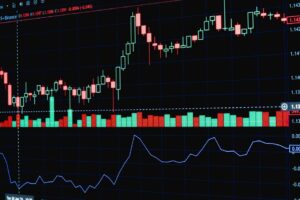
Candlestick charts show four data points for each time period (hourly, daily, weekly): open price, close price, high price, and low price. The body of the candle shows the open-close range, while the wicks show the high and low.
Key beginner patterns to recognize:
- Doji: Open and close prices nearly identical, indicating indecision
- Hammer: Small body with long lower wick, suggesting buyers stepped in at lows
- Bearish Engulfing: A larger red candle fully encompasses the previous green candle, showing seller dominance
- Morning Star: Three candles showing a reversal pattern from downtrend to uptrend
Moving Averages as Entry Signals
A moving average smooths out price data by calculating an average over a specified period. The 50-day moving average and 200-day moving average are particularly useful for beginners.
A simple strategy: when price rises above the 200-day moving average, it suggests an uptrend. When price falls below it, a downtrend may be forming. Many institutional traders watch these exact levels, making them self-fulfilling signals.
Relative Strength Index (RSI)
The RSI measures momentum on a scale of 0-100. Readings above 70 suggest an asset is overbought, while readings below 30 suggest oversold conditions. However, do not use RSI alone—in strong bull markets, RSI can remain above 70 for extended periods. Always combine RSI with price action and moving averages.
Strategy 3: Trend Following and Support/Resistance
What Are Support and Resistance Levels?
Support is a price level where buyers historically step in, preventing further decline. Resistance is where sellers emerge, preventing further upside. These aren’t magical lines—they represent areas where large numbers of traders have made decisions before.
For example, if Bitcoin bounced off $40,000 multiple times in the past month, $40,000 becomes support. New traders anticipate bounces at this level, making it a self-fulfilling level.
Identifying Trends
A uptrend consists of higher highs and higher lows. A downtrend shows lower highs and lower lows. The simplest profitable strategy for beginners is trend following: buy during established uptrends and avoid selling during them.
This contradicts the common beginner impulse to “buy the dip” constantly. Instead, trend followers wait for price to confirm a move above resistance before entering. Yes, you miss some of the move, but you avoid countless false signals and whipsaws.
The Trend Line Method
Draw a line connecting two or more low points in an uptrend. Price bouncing off this line repeatedly suggests the trend is healthy. When price breaks below this trend line with volume, the trend may be ending. This simple visual tool has been used by traders for decades because it works.
Strategy 4: Position Sizing and Risk Management
The 1-2% Rule
Professional traders never risk more than 1-2% of their total trading capital on any single trade. This rule prevents a few bad trades from decimating your account.
Here’s how it works: If you have a $10,000 trading account and you’re willing to risk 1%, you can lose a maximum of $100 per trade. If you place a trade and set a stop-loss at $100 below your entry, you can position size accordingly.
Example: Bitcoin enters at $45,000, stop-loss at $44,900 ($100 risk). Your portfolio is $10,000. You can buy 0.01 BTC (one hundredth of your account), risking exactly $100.
Stop-Losses and Take-Profits
Always set a stop-loss before entering a trade. A stop-loss is a pre-determined exit price that limits your loss if the trade moves against you. Without one, you’re gambling, not trading.
Similarly, set a take-profit target. If you’re risking $100 to potentially make $200, that’s a favorable 1:2 risk-reward ratio. Only take trades where potential gains exceed potential losses.
Portfolio Allocation
Even with perfect strategy execution, diversification matters. A beginner portfolio might look like:
- 60% in established cryptocurrencies (Bitcoin, Ethereum) via DCA
- 25% in secondary cryptocurrencies with potential growth
- 15% in stablecoins for cash reserves and dry powder
This structure ensures you’re not “all in” on one bet while maintaining exposure to potential upside.
Strategy Comparison Table
| Strategy | Time Commitment | Emotion Involved | Best For | Risk Level |
|---|---|---|---|---|
| Dollar-Cost Averaging | Very Low (automated) | Low | Long-term investors, beginners | Medium |
| Technical Analysis | Moderate (daily charts) | Medium | Active traders, pattern seekers | Medium-High |
| Trend Following | Low-Moderate (weekly) | Low | Patient traders, position traders | Medium |
| Risk Management | Minimal (planning) | Low | All traders (essential) | Reduced |
Risks and Considerations
Market Volatility
Cryptocurrency markets operate 24/7 without circuit breakers. A major news event can cause 10-20% price swings in hours. Only invest money you can afford to lose completely. If a sudden 50% drop would devastate your finances, you’re using too much leverage or too large a position.
Psychological Challenges
Fear and greed drive most trading losses. When the market crashes 30%, your instinct screams “sell everything!” When it rallies 100%, FOMO (fear of missing out) pushes you to chase highs. Written trading plans remove emotion. Write down your strategy, entry rules, exit rules, and position sizes before you trade. Stick to the plan even when it feels wrong.
Exchange Risk
Not all cryptocurrency exchanges are equal. Use established, regulated platforms with proven security records. Research insurance policies for account balances. Consider keeping only trading capital on exchanges; store long-term holdings in self-custodied wallets where you control the private keys.
Leverage and Margin Trading
Beginner traders should never use leverage. Margin trading allows you to borrow funds to amplify gains—but also amplifies losses. A 2x leveraged position means a 50% market move against you wipes out your entire position. Most exchanges reset leveraged positions during volatility spikes, locking in losses for borrowers.
Regulatory Uncertainty
Cryptocurrency regulation is evolving. Tax implications vary by jurisdiction. Exchanges may face shutdowns or restrictions. Stay informed about regulatory developments in your country and consult a tax professional about reporting requirements.
Frequently Asked Questions
How much money should a beginner start with?
Start with an amount you can genuinely afford to lose without affecting your financial stability. Many successful traders began with $500-$1,000. The size of your account matters far less than the consistency of your strategy and discipline with position sizing. A $500 account with proper 1% risk management will teach you more than a $50,000 account traded recklessly.
Should I use leverage as a beginner?
No. Absolutely not. Leverage is one of the fastest ways for beginners to destroy their trading capital. Even with correct strategy, a sudden market spike can trigger liquidation of leveraged positions during volatile periods. Master trading without leverage first. If you ever do use