- Key Takeaways
- Table of Contents
- Understanding Chatbot Limitations
- What Exactly is Agentic AI?
- Key Differences Between Chatbots and Agentic AI
- Autonomy and Decision-Making
- Action Capability
- Continuous Operation
- Context and Memory
- Tool Integration
- Real-World Applications of Agentic AI
- Business Operations and Automation
- Financial Services and Analysis
- Research and Data Analysis
- Customer Service Evolution
- Software Development
- Challenges and Considerations
- Accountability and Liability
- Safety and Control
- Transparency and Explainability
- Integration Complexity
- Hallucinations and Errors
- The Future Landscape of AI
- Frequently Asked Questions
- What's the main difference between a chatbot and agentic AI?
- Can chatbots become agentic AI?
- Is agentic AI safe to use in critical applications?
- When will agentic AI become mainstream?
- About the Author
Category: Agentic AI Basics
Why Agentic AI is the next leap beyond chatbots
Discover how agentic AI systems are revolutionizing automation and decision-making beyond what traditional chatbots can accomplish.
Key Takeaways
- Agentic AI goes beyond conversation – It takes actions, makes decisions, and operates autonomously toward specific goals
- Chatbots are reactive – They respond to user input but don’t initiate tasks or solve problems independently
- Real-world automation is agentic AI’s strength – From scheduling to data analysis, agentic systems handle complex workflows
- Trust and transparency matter – As agentic AI becomes more autonomous, explainability becomes crucial
- The future is hybrid – Agentic AI combined with human oversight will drive next-generation business solutions
Table of Contents
Understanding Chatbot Limitations
Since ChatGPT’s explosive growth in 2022, chatbots have become the public face of artificial intelligence. They’re everywhere – customer service, content creation, coding assistance, and customer support. But here’s the truth: chatbots are fundamentally limited in what they can accomplish.
Traditional chatbots operate on a simple principle: they wait for user input, process the request, and generate a response. They excel at answering questions, explaining concepts, and drafting content. However, they’re passive. They don’t take actions in the real world. They can’t schedule your meetings, execute code, send emails, or analyze databases without human intervention at every step.
Consider a practical scenario: You ask a chatbot to “organize my calendar for next week.” The chatbot might provide suggestions or a written plan, but it cannot actually:
- Access your calendar application
- Check your existing commitments
- Send meeting invitations
- Adjust times based on conflicts
- Notify relevant parties
You still need to manually implement everything it suggests. This is the fundamental gap that agentic AI is designed to bridge.
What Exactly is Agentic AI?
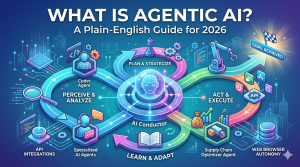
Agentic AI refers to artificial intelligence systems that can independently perform tasks, make decisions, and take actions toward achieving predefined goals without requiring human input at every step.
Unlike chatbots that respond to queries, agentic AI systems are goal-oriented and autonomous. They can:
- Set and prioritize objectives
- Break complex tasks into subtasks
- Access external tools and APIs
- Make decisions based on real-time data
- Learn from outcomes and adjust strategy
- Operate continuously without user prompts
An agentic AI system might be given a high-level goal like “reduce customer churn by 15% this quarter.” The system would then autonomously analyze customer data, identify at-risk accounts, develop retention strategies, implement interventions, monitor results, and adjust tactics based on performance metrics.
This represents a fundamental shift from reactive assistance (responding to questions) to proactive problem-solving (independently working toward objectives).
Key Differences Between Chatbots and Agentic AI
Autonomy and Decision-Making
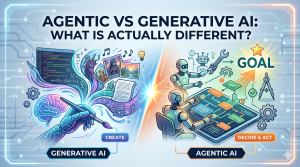
Chatbots operate within strict boundaries. They process input and generate output but never deviate from this pattern. Agentic AI systems, by contrast, make independent decisions about which actions to take, which tools to use, and how to sequence their operations to achieve goals.
Action Capability
A chatbot can discuss how to fix a bug in your code. An agentic AI system can access your repository, identify the bug, create a fix, run tests, and submit a pull request – all without asking for permission at each step.
Continuous Operation
Chatbots are conversational – they exist within a chat interface waiting for the next message. Agentic AI systems can operate continuously in the background, monitoring conditions, executing scheduled tasks, and responding to changing circumstances.
Context and Memory
While both can maintain conversation history, agentic AI systems maintain persistent memory of long-term goals, strategies, and historical performance across multiple interactions and time periods.
Tool Integration
Modern chatbots can integrate with tools through plugins, but this typically requires explicit user commands. Agentic AI systems automatically determine which tools to use based on the task requirements and can chain multiple tools together in sophisticated workflows.
Real-World Applications of Agentic AI
Business Operations and Automation
Agentic AI can manage entire business processes. An agentic system might handle procurement by identifying needed supplies, comparing vendor quotes, negotiating prices, placing orders, tracking deliveries, and managing payments – creating significant efficiency gains.
Financial Services and Analysis
In finance, agentic AI systems can monitor market conditions, analyze portfolio performance, rebalance investments, and execute trades based on predefined strategies and risk parameters. They provide continuous portfolio management without human traders managing every decision.
Research and Data Analysis
Researchers can deploy agentic AI to autonomously conduct literature reviews, design experiments, collect and analyze data, identify patterns, and generate preliminary findings. This accelerates the research process dramatically.
Customer Service Evolution
Beyond answering questions, agentic AI can resolve customer issues completely. It can issue refunds, reschedule services, coordinate with logistics partners, and follow up on resolution – delivering comprehensive customer service without human handoffs.
Software Development
Agentic AI developers can take feature specifications and independently build, test, and deploy working software. They can refactor code, optimize performance, and fix bugs autonomously.
Challenges and Considerations
Accountability and Liability
When an agentic AI system makes an autonomous decision that causes problems, who is responsible? This legal and ethical question remains largely unresolved and will shape how agentic AI is deployed in critical domains.
Safety and Control
Autonomous systems require robust safety mechanisms. An agentic AI system pursuing its goal might take unexpected actions if not properly constrained. Building systems that remain aligned with human values while maintaining autonomy is a significant challenge.
Transparency and Explainability
Users need to understand why an agentic AI took specific actions. Unlike chatbots where you see the reasoning in the response, agentic systems often operate invisibly. Ensuring these systems provide clear explanations of their decision-making is crucial for trust.
Integration Complexity
Deploying agentic AI requires extensive integration with existing systems, databases, and APIs. This technical complexity means implementation costs remain high for most organizations.
Hallucinations and Errors
The same AI limitations that cause chatbots to hallucinate or provide incorrect information still apply to agentic systems. However, the consequences are more severe when the AI acts autonomously on false information.
The Future Landscape of AI
The trajectory is clear: AI is moving from conversational assistance toward autonomous agency. This doesn’t mean chatbots will disappear. Rather, we’ll see a spectrum of AI capabilities:
- Pure Chatbots – For information and advice where human decision-making remains important
- Hybrid Systems – AI that operates autonomously but requires human approval for significant actions
- Fully Agentic AI – Autonomous systems managing well-defined domains with clear success metrics
Organizations that successfully deploy agentic AI will gain significant competitive advantages through automation, speed, and operational efficiency. However, success requires careful consideration of safety, ethics, and integration challenges.
The companies leading this transition are those combining agentic AI capabilities with robust oversight mechanisms, clear accountability structures, and transparent decision-making processes.
Frequently Asked Questions
What’s the main difference between a chatbot and agentic AI?
The fundamental difference is autonomy and action. Chatbots respond to questions you ask them – they’re reactive and conversational. Agentic AI independently works toward goals, takes actions in real-world systems, and operates without constant user input. A chatbot tells you what to do; agentic AI does it for you.
Can chatbots become agentic AI?
Current chatbots can be given agentic capabilities by connecting them to tools and APIs that allow them to take actions. However, this doesn’t fundamentally change their nature – they still require prompting to take action. True agentic AI operates continuously toward goals without needing to be prompted for every action. Some systems blur this line, but the distinction remains: one is fundamentally responsive, the other is fundamentally autonomous.
Is agentic AI safe to use in critical applications?
Agentic AI in critical applications (healthcare, finance, infrastructure) requires extensive safety mechanisms, human oversight, and clear boundaries. Current technology is best suited for agentic AI deployment in well-defined domains with clear success metrics and room for error recovery. As the technology matures and safety mechanisms improve, applications in higher-stakes domains will expand, but this is still an evolving area.
When will agentic AI become mainstream?
Agentic AI is already emerging in specialized applications, particularly in business automation and software development. Mainstream adoption will accelerate as companies solve integration challenges, develop clearer governance frameworks, and prove ROI. Expect significant growth over the next 2-3 years, with widespread adoption within 5 years for routine business processes.
“`