- Key Takeaways
- What is Forex Trading?
- Why Beginners Are Attracted to Forex
- Realistic Expectations for 2026
- Can Beginners Make Money?
- 2026 Market Conditions
- Getting Started with Forex Trading
- Step 1: Get Educated
- Step 2: Use a Demo Account
- Step 3: Choose a Regulated Broker
- Step 4: Start Small
- Essential Trading Strategies for Beginners
- 1. Price Action Trading
- 2. Trend Following
- 3. Range Trading
- 4. Fundamental-Based Trading
- The Common Thread
- A Worked Example: Walking Through a Beginner Trade
- The Psychology of Trading: Why Most Beginners Fail
- Understanding the Risks
- Leverage Risk
- Emotional Risk
- Operational Risk
- Regulatory Risk
- Black Swan Events
- Costs That Quietly Eat Your Profits
- Building a Trading Plan That Actually Works
- Frequently Asked Questions
- Q: How much money do I need to start forex trading?
- Q: Can I make a living from forex trading in 2026?
- Q: What's the best currency pair for beginners?
- Q: Is forex trading gambling?
- Q: Do I need a lot of technical knowledge or a finance background to start?
- Conclusion
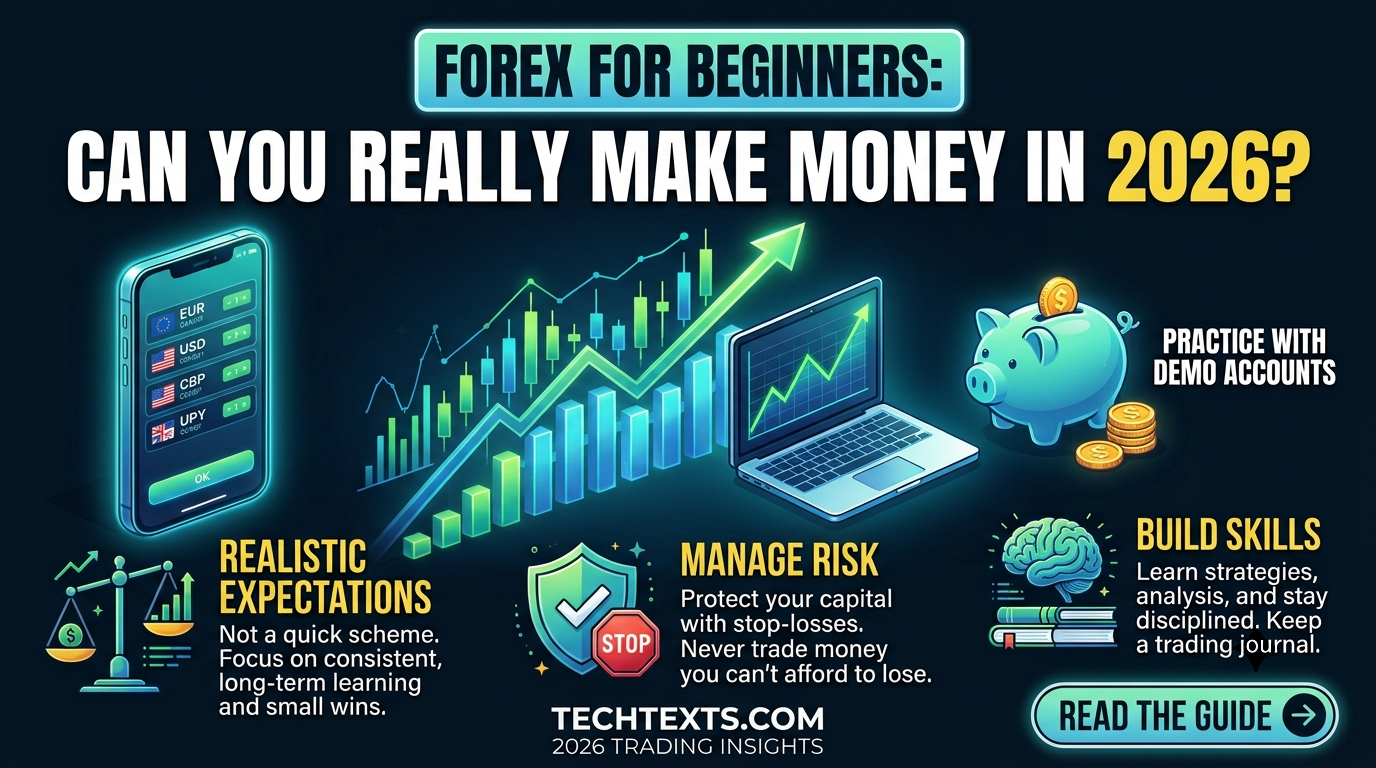
Key Takeaways
- Forex trading is accessible to beginners, but success requires education and discipline, not luck or intuition.
- The average retail trader loses money; realistic profit expectations are essential before you deposit a single dollar.
- Starting with a demo account and small position sizes significantly improves survival rates during the learning curve.
- Risk management is more important than finding winning trades — professional traders obsess over losses, not wins.
- 2026 presents both opportunities and challenges due to economic volatility, tighter regulation, and AI-powered algorithmic trading dominating volume.
- It typically takes 1–2 years of consistent practice, and often longer, to develop genuinely profitable trading skills.
- Trading psychology, not chart patterns, is usually the deciding factor between traders who survive and traders who blow up their accounts.
What is Forex Trading?
The foreign exchange market, or forex, is the decentralized global marketplace where currencies are traded against one another. With a daily trading volume exceeding $6 trillion, it’s the largest and most liquid financial market in the world — dwarfing global stock markets combined. Unlike stock exchanges with fixed trading hours, forex operates 24 hours a day, five days a week, rotating across major financial centers: Sydney, Tokyo, London, and New York.
When you trade forex, you’re essentially betting on the relative strength of one currency against another. For example, if you buy the EUR/USD pair, you’re purchasing euros while simultaneously selling dollars, speculating that the euro will appreciate relative to the dollar. If your prediction is correct, you profit from the difference; if you’re wrong, you absorb the loss.
Currency pairs are grouped into three broad categories, and understanding this grouping matters more than most beginner guides admit:
- Major pairs — pairs that include the US dollar and a highly liquid currency, such as EUR/USD, USD/JPY, GBP/USD, and USD/CHF. These carry the tightest spreads and the most predictable behavior, making them the natural starting point for beginners.
- Minor pairs (crosses) — pairs that don’t include the US dollar, such as EUR/GBP or AUD/JPY. Spreads are wider and liquidity is thinner, which increases the cost of trading and the risk of slippage.
- Exotic pairs — pairs involving a major currency and a currency from a developing economy, such as USD/TRY or USD/ZAR. These can move violently on political or economic news and are best avoided until you have significant experience.
Why Beginners Are Attracted to Forex
- Low barrier to entry — some brokers accept deposits under $100.
- High leverage availability — up to 50:1 in the US, and often much higher internationally, meaning you can control a large position with a small deposit.
- 24/5 market availability, which fits around a day job, studies, or family schedule far better than the stock market’s fixed hours.
- No significant commissions on most retail accounts — brokers profit from the spread (the small difference between buy and sell prices) rather than charging per trade.
- An abundance of free educational resources, demo accounts, and trading communities, lowering the cost of learning compared to other markets.
It’s worth being honest about the flip side of this accessibility, too: the same low barrier to entry that makes forex appealing is exactly why so many beginners lose money quickly. Anyone can open an account in minutes, but very few take the time to actually learn the market before risking real capital.
Realistic Expectations for 2026
Let’s address the elephant in the room: the majority of retail forex traders lose money. Studies from regulators and brokers alike suggest that 70–90% of retail traders are unprofitable over any meaningful time horizon. This isn’t pessimism — it’s a statistical reality you must accept before risking your capital. Any guide, course, or “signal service” that promises otherwise without acknowledging this reality should be treated with suspicion.
Can Beginners Make Money?
Yes, but with significant caveats. A subset of traders do become consistently profitable, and they share common characteristics that separate them from the majority:
- Education first. They invest weeks or months in learning market mechanics before risking real money, rather than treating their first live trade as a learning exercise.
- Risk management. They never risk more than 1–2% of their account on a single trade, regardless of how confident they feel.
- Patience. They understand profitability typically takes 6–24 months to achieve, and they don’t expect to quit their job in month three.
- Emotional discipline. They follow their trading system without deviation, even when a trade “feels” wrong or a loss stings.
- Continuous improvement. They keep detailed trading journals, review their mistakes honestly, and adjust their strategies based on data rather than gut feeling.
What separates the profitable minority from everyone else usually isn’t a secret indicator or insider knowledge — it’s the boring, unglamorous combination of preparation, small position sizes, and consistency applied over a long enough period to smooth out the inevitable losing streaks.
2026 Market Conditions
Looking ahead through 2026, the forex landscape presents some genuinely new characteristics that beginners in previous decades didn’t have to contend with:
- Increased AI competition. Algorithmic and AI-driven trading now dominates well over 70% of forex volume, meaning retail traders are frequently on the other side of trades executed by institutional systems with faster data feeds and more sophisticated models. This doesn’t make retail trading impossible, but it does mean beginners are competing in a faster, more efficient market than a decade ago.
- Economic uncertainty. Geopolitical tensions, shifting interest rate policy across major central banks, and ongoing trade friction create both opportunities and whipsaw risk — sudden reversals that can trigger stop-losses in both directions within the same session.
- Regulatory tightening. More jurisdictions are implementing trader protection measures, including leverage caps, negative balance protection, and mandatory risk warnings, which is generally positive for beginners even if it feels restrictive at first.
- Improved accessibility. Trading platforms, charting tools, and educational resources are more sophisticated and more freely available than at any point in forex history, which partially offsets the increased competition from algorithmic trading.
The practical takeaway is that 2026 is not a uniquely good or uniquely bad year to start — it’s a year where the tools available to beginners are better than ever, but the competitive landscape (especially against algorithmic flow) is also tougher than ever. Neither factor changes the fundamentals: education, risk management, and patience still decide outcomes.
Getting Started with Forex Trading
Step 1: Get Educated
Before opening a live account, dedicate 3–6 months to learning the market properly. Rushing this stage is the single most common reason beginners lose their initial deposit within the first few weeks. Focus on:
- Currency pairs and their individual characteristics — volatility, typical trading sessions, and correlation with other pairs.
- Reading candlestick charts and technical analysis basics, including support, resistance, and trend structure.
- Understanding fundamental analysis — interest rate decisions, inflation reports, employment data, and how central bank policy moves currencies.
- Learning position sizing and risk management calculations, including how to calculate pip value and appropriate lot sizes for your account.
- Studying price action and how markets behave around key support and resistance levels, including false breakouts and liquidity grabs.
Step 2: Use a Demo Account
Most regulated brokers offer free demo accounts funded with virtual money that mirrors live market conditions. Trade on a demo account for at least 2–3 months before considering real capital. Your goal during this period isn’t just to “practice” — it’s to develop measurable, consistent profitability under simulated conditions.
If you can’t be profitable on a demo account, where emotions are lower and mistakes are free, you certainly won’t be profitable with real money on the line. Treat demo trading with the same seriousness as live trading: keep a journal, track your win rate, and calculate your risk-to-reward ratio just as you would with real capital.
Step 3: Choose a Regulated Broker
Only trade with brokers regulated by recognized financial authorities. Regulation doesn’t guarantee profits, but it does guarantee a baseline of consumer protection, segregated client funds, and recourse if something goes wrong. Key regulators include:
- United States — CFTC and NFA
- United Kingdom — FCA
- Europe — ESMA (and national regulators such as BaFin or CySEC, depending on jurisdiction)
- Australia — ASIC
Before depositing money, verify the broker’s regulatory license number directly on the regulator’s website rather than trusting a badge displayed on the broker’s homepage. Avoid brokers offering leverage above 50:1 in the US, or brokers operating from unregulated offshore jurisdictions with no meaningful oversight — these are disproportionately linked to withdrawal problems and outright fraud.
Step 4: Start Small
When you finally trade live money, start with a micro account — trading micro lots (1,000 units) instead of standard lots (100,000 units). This allows you to experience real emotional pressure, real slippage, and real broker execution quality, all while risking amounts small enough that mistakes don’t end your trading career before it starts. Many experienced traders recommend spending 6–12 months trading exclusively in micro lots before considering any increase in position size.
Essential Trading Strategies for Beginners
1. Price Action Trading
Rather than relying on a cluttered chart full of complex indicators, price action traders study how price itself moves relative to support and resistance levels. This approach requires patience and a genuine understanding of market structure, but it teaches skills that transfer across every currency pair and timeframe. Beginners should focus first on recognizing candlestick patterns (such as pin bars and engulfing candles) and clean breakouts from consolidation ranges, rather than trying to memorize dozens of indicator combinations.
2. Trend Following
The phrase “the trend is your friend” remains valid in 2026, and for good reason: trending markets tend to persist longer than beginners expect, rewarding traders who align with momentum rather than fight it. A simple moving average crossover system — using, for example, 20-period and 50-period moving averages — can be profitable when combined with proper risk management and realistic profit targets. This strategy works well because it aligns trades with the dominant market direction rather than attempting to predict reversals, which is a far harder skill to execute consistently.
3. Range Trading
When prices oscillate between clear support and resistance without establishing a trend, range trading buys near support and sells near resistance, aiming to capture the oscillation itself. This approach works particularly well on shorter timeframes (1–4 hour charts) during consolidation phases, which are common during low-volatility sessions such as the Asian trading session. The key risk is that ranges eventually break, so range traders must watch for signs of an impending breakout and exit or adjust accordingly.
4. Fundamental-Based Trading
Rather than trying to predict price purely from charts, some traders react directly to major economic announcements — interest rate decisions, non-farm payroll reports, inflation data, and central bank commentary. Trading around these events can create significant, fast-moving opportunities, but it also carries higher risk due to increased volatility and wider spreads during the announcement itself. This approach requires a solid understanding of the economic calendar and how markets typically react to specific data surprises, but it reduces the guesswork element compared to pure technical analysis.
The Common Thread
Successful strategies share one defining characteristic: they have a positive expectancy with proper position sizing. No strategy wins every trade, and no professional trader expects one to. Your job as a beginner isn’t to find a “perfect” system — it’s to find a system that wins more than it loses by a sufficient margin to overcome spreads, slippage, and the occasional string of losing trades that every strategy eventually experiences.
A Worked Example: Walking Through a Beginner Trade
Abstract strategy descriptions only go so far, so it helps to see the mechanics applied to a single, realistic trade.
Imagine a beginner trading a $1,000 micro account, following a simple trend-following approach on EUR/USD. The 20-period moving average has just crossed above the 50-period moving average on the 4-hour chart, signaling a potential uptrend. Price has pulled back to a previous resistance level, which is now acting as support — a classic entry signal in trend-following systems.
Following proper risk management, the trader risks 1% of the account, or $10, on this trade. They set a stop-loss 30 pips below their entry, at the recent swing low, and a take-profit target 60 pips above their entry, giving a 1:2 risk-to-reward ratio. Using a position size calculator, this translates to a micro lot position sized so that a 30-pip move against them equals exactly $10.
If the trade works, the trader gains $20 (2% of the account). If it fails, they lose $10 (1% of the account) — a loss small enough to absorb without emotional damage, and small enough that even a string of five consecutive losses would only reduce the account by roughly 5%. This is the discipline that separates traders who survive long enough to become profitable from those who don’t: the individual outcome of any single trade matters far less than consistent, controlled position sizing applied across dozens or hundreds of trades.
The Psychology of Trading: Why Most Beginners Fail
Most beginner trading guides focus heavily on strategy and barely mention psychology, yet experienced traders consistently rank psychology as the deciding factor between success and failure. Understanding the market is necessary but not sufficient — you also have to manage your own behavior under financial and emotional pressure.
- Fear of missing out (FOMO) drives beginners to jump into trades after a move has already happened, chasing price rather than waiting for a proper setup.
- Revenge trading occurs after a loss, when a trader increases their position size or abandons their rules in an attempt to “win back” the money quickly, usually resulting in larger losses.
- Overconfidence after a winning streak leads traders to abandon risk management just when discipline matters most, often right before a losing streak begins.
- Analysis paralysis affects beginners who study so many indicators and strategies that they become unable to pull the trigger on any trade with confidence.
- Confirmation bias causes traders to only notice information that supports a trade they already want to take, while ignoring warning signs that contradict their view.
Combating these tendencies isn’t about eliminating emotion entirely — that’s unrealistic — but about building a trading plan detailed enough that decisions are made in advance, during calm moments, rather than in the heat of a live trade. Traders who journal their trades, including the emotional state they were in at the time, tend to identify and correct these patterns far faster than those who don’t.
Understanding the Risks
Leverage Risk
While leverage allows you to control large positions with relatively small capital, it’s a double-edged sword that amplifies both gains and losses equally. A 50:1 leverage ratio means a mere 2% move against you can wipe out your entire account balance. Most beginners significantly underestimate this risk, treating leverage as “free money” rather than a tool that magnifies the consequences of every decision.
Emotional Risk
Losing money triggers powerful emotional responses — fear and greed dominate decision-making far more than most beginners expect before they experience it firsthand. Traders commonly abandon well-tested systems after a single loss, or hold onto winning positions too long while hoping for even bigger gains, undermining their own strategy in the process. Developing emotional discipline is arguably more important than technical chart-reading skill, since even a mediocre strategy executed with discipline will outperform an excellent strategy executed inconsistently.
Operational Risk
Technical failures, slippage (price executing at a worse level than expected), and gap risk during market opens — particularly after weekends or major news events — can result in losses larger than your intended stop-loss order. Beginners should test their broker’s execution quality on a demo account and understand exactly how their platform handles fast-moving markets before relying on it with real capital.
Regulatory Risk
Changing regulations can affect leverage availability, permitted instruments, and broker operations, sometimes with little advance notice. Staying informed about regulatory developments in your jurisdiction protects your capital and helps you anticipate changes that might affect your trading strategy or account terms.
Black Swan Events
Unexpected geopolitical or economic shocks — a surprise central bank announcement, an unanticipated political crisis, or a sudden liquidity crunch — can create massive, near-instantaneous price movements. Even proper risk management, including stop-loss orders, can’t fully protect against extreme market moves that exceed historical volatility parameters, since stop-losses can “gap” past their intended execution price during periods of illiquidity.
Costs That Quietly Eat Your Profits
Beyond the obvious risk of losing trades, several less visible costs erode profitability over time, and beginners frequently overlook them when calculating whether a strategy is actually working.
- The spread — the difference between the buy and sell price — is effectively a cost paid on every single trade, even winning ones. Wider spreads on minor and exotic pairs can quietly consume a meaningful portion of your profit target before the trade even moves in your favor.
- Overnight financing (swap) fees apply when positions are held open past a specific daily cutoff time, and these can add up significantly for traders who hold trades for multiple days or weeks.
- Slippage during volatile periods means your actual entry or exit price may differ from your intended price, particularly around major news releases.
- Withdrawal and inactivity fees, charged by some brokers, can reduce your net returns even when your trading itself is profitable.
Factoring these costs into your expected profitability — rather than only counting pips won and lost on a chart — gives a far more realistic picture of whether a strategy is genuinely viable.
Building a Trading Plan That Actually Works
A trading plan is the single document that ties education, strategy, and risk management together, and beginners who skip this step tend to trade reactively rather than systematically. At minimum, a solid trading plan should specify:
- Which currency pairs you will trade, and which you will deliberately avoid.
- The exact conditions that define a valid entry signal for your chosen strategy.
- Your maximum risk per trade (typically 1–2% of account equity) and your maximum daily or weekly loss limit, at which point you stop trading for the day or week.
- Your stop-loss and take-profit rules, decided before entering the trade rather than adjusted emotionally afterward.
- A journaling process that records not just the trade’s outcome, but the reasoning and emotional state behind it.
Writing this down — rather than keeping it as a loose mental framework — forces the kind of consistency that separates traders who improve over time from traders who repeat the same mistakes indefinitely.
Frequently Asked Questions
Q: How much money do I need to start forex trading?
A: Technically, some brokers accept deposits as low as $10–25. However, to trade meaningfully and absorb the inevitable learning curve, most experienced traders recommend starting with $500–1,000. This allows for genuine micro lot trading while maintaining emotional control — an amount substantial enough to matter, but not so large that losing it during the learning phase would be financially devastating.
Q: Can I make a living from forex trading in 2026?
A: Yes, but realistically, fewer than 10% of retail traders achieve this. Those who do typically have professional-level risk management, strong psychological discipline, and have spent 2–5 years deliberately developing their skills before relying on trading income. Don’t expect to replace your job income in the first 1–2 years, and be wary of anyone who claims this is easily achievable.
Q: What’s the best currency pair for beginners?
A: EUR/USD is widely considered ideal for beginners because it has tight spreads, extremely high liquidity, and tends to move in relatively predictable ways based on observable economic factors. Avoid exotic pairs and volatile commodity-linked currencies, which can exhibit sudden, unpredictable behavior driven by factors that are harder for a beginner to anticipate.
Q: Is forex trading gambling?
A: Forex trading can function as gambling if approached without a plan, without risk management, and without genuine market understanding — essentially betting on random price movement. However, when approached as a skill-based discipline, with defined strategies, controlled position sizing, and continuous review of results, it more closely resembles a probability-based profession, similar to how a professional poker player treats individual hands as part of a much longer statistical process.
Q: Do I need a lot of technical knowledge or a finance background to start?
A: No formal background is required, but a working understanding of basic economics — how interest rates, inflation, and employment data influence currency values — significantly improves decision-making. Most successful retail traders are self-taught through demo practice, educational content, and their own trading journals, rather than through formal financial education.
Conclusion
Can you make money trading forex in 2026? Absolutely — but only if you approach it as a serious skill requiring education, practice, and discipline, rather than as a get-rich-quick scheme or a shortcut to financial freedom.
The realistic path looks like this: spend 3–6 months learning the fundamentals, trade a demo account for 2–3 months to prove consistency, start with micro lots for 6–12 months to build real experience under real emotional pressure, and only then consider gradually scaling up your position sizes. By year two or three, if you’ve survived the learning curve, maintained discipline through losing streaks, and kept a detailed trading journal, consistent profitability becomes a genuinely realistic outcome rather than a fantasy.
Remember: protecting your capital is more important than making spectacular profits, especially in the early stages. The traders who thrive in 2026 will be those who understand that forex is a long-term skill development journey shaped by risk management and psychology, not a short-term gambling venture shaped by luck.
Start small, learn relentlessly, track your results honestly, and never risk money you can’t afford to lose. Do that, and you’ll be among the minority who actually make money in forex.