- Key Takeaways
- What is Customer Journey Analytics?
- The Core Components
- Why Tracking Touchpoints Matters
- The Impact of Multi-Touch Journeys
- Business Benefits
- Attribution Models Explained
- 1. First-Click Attribution
- 2. Last-Click Attribution
- 3. Linear Attribution
- 4. Time-Decay Attribution
- 5. Data-Driven Attribution
- Choosing the Right Model for Your Business
- Tools and Platforms for Tracking
- Google Analytics 4
- Mixpanel
- Segment
- HubSpot
- Adobe Analytics
- Choosing Between Tools
- Implementing Customer Journey Tracking
- Step 1: Define Your Customer Journey Stages
- Step 2: Set Up Tracking Infrastructure
- Step 3: Establish Data Governance
- Step 4: Choose and Configure Your Attribution Model
- Step 5: Build Dashboards and Reporting Cadence
- Step 6: Test, Validate, and Iterate
- Privacy and Data Governance in 2026
- Common Challenges and Solutions
- Challenge: Data Silos Across Tools
- Challenge: Cross-Device and Cross-Browser Tracking Gaps
- Challenge: Attribution Model Disagreements Between Teams
- Challenge: Offline Touchpoints Are Hard to Capture
- Challenge: Data Volume Too Low for Data-Driven Attribution
- Frequently Asked Questions
- Q: What's the difference between customer journey analytics and standard web analytics?
- Q: How many touchpoints should I expect before a conversion?
- Q: Which attribution model should a small business start with?
- Q: Can I still do accurate journey tracking with increasing privacy restrictions?
- Q: How often should I review and adjust my attribution model?
- Conclusion
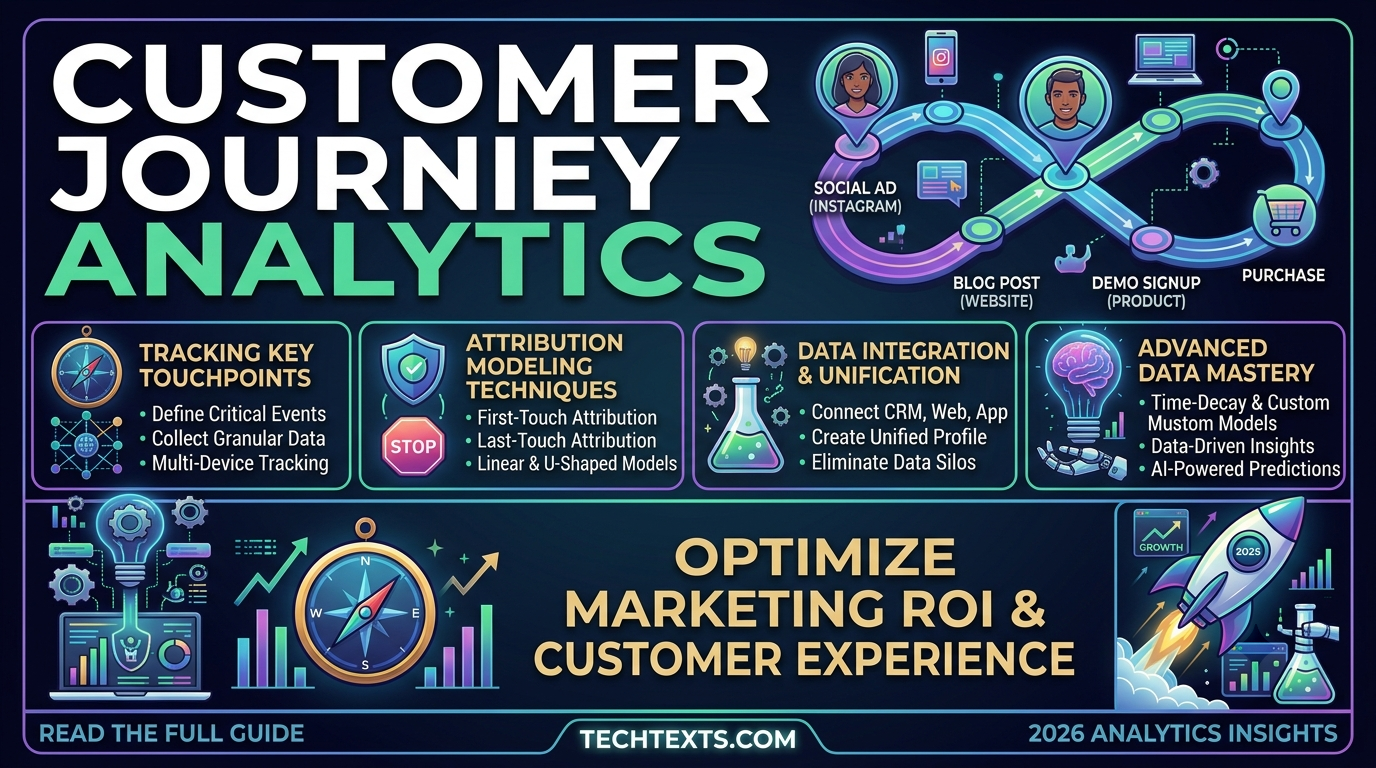
Key Takeaways
- Customer journey analytics helps you understand how customers interact with your brand across multiple touchpoints before converting.
- Attribution modeling is critical for allocating marketing budget effectively — companies using multi-touch attribution report meaningfully higher marketing ROI than those relying on single-touch models.
- The five main attribution models are first-click, last-click, linear, time-decay, and data-driven models.
- Modern tools like Google Analytics 4, Mixpanel, and Segment enable real-time tracking across web, mobile, and offline channels.
- Implementing customer journey analytics requires careful planning of tracking infrastructure and proper data governance, especially as privacy regulations continue to tighten.
- Privacy changes — from cookie deprecation to stricter consent requirements — are reshaping how journey data can be collected and stitched together in 2026.
What is Customer Journey Analytics?
Customer journey analytics is the practice of tracking, measuring, and analyzing every interaction a customer has with your brand across all channels and touchpoints. From the moment someone first hears about your company to post-purchase support, these interactions create a roadmap of the customer experience.
Unlike traditional analytics that focus on individual sessions or page views, customer journey analytics stitches together data from multiple sources to create a holistic view of each customer’s path to conversion. This comprehensive approach reveals which marketing efforts truly drive results and where customers drop off in the funnel.
The Core Components
- Touchpoints: Every interaction point including website visits, email clicks, social media engagement, ads, and phone calls.
- Channels: The platforms where touchpoints occur — organic search, paid ads, email, social media, direct, referral, and offline.
- Events: User actions tracked within each touchpoint, like page views, form submissions, or purchases.
- Attribution: The process of crediting channels for conversions based on their role in the customer journey.
- Identity resolution: The process of recognizing that interactions across different devices and sessions belong to the same underlying customer — increasingly difficult, and increasingly important, as journeys span more channels and devices.
Why Tracking Touchpoints Matters
Understanding touchpoints is essential because the modern customer journey rarely consists of a single interaction. According to HubSpot research, the average B2B buyer interacts with over 11 different pieces of content before making a purchase decision. For B2C customers, the number of touchpoints varies but typically ranges from 5–15 interactions, and complex or high-consideration purchases (like enterprise software or big-ticket consumer goods) often involve substantially more.
The Impact of Multi-Touch Journeys
If you rely solely on last-click attribution, you’re missing the bigger picture. A customer might:
- Discover your brand through a social media ad
- Read educational content from an organic search
- Receive an email nurture sequence
- Click a retargeting ad
- Finally convert after visiting your website directly
In a last-click attribution model, the direct visit gets all the credit. But every touchpoint contributed to that final decision. By tracking each interaction, you gain insights into which channels truly influence conversions and can optimize your marketing mix accordingly — rather than defunding the awareness-stage channels that quietly set up every later conversion.
Business Benefits
- Improved ROI: Allocate budgets to the channels and campaigns that actually drive conversions, rather than the ones that merely appear to based on incomplete data.
- Better Customer Experience: Understand pain points and optimize the journey at the specific stages where customers struggle or drop off.
- Competitive Advantage: Make data-driven decisions faster than competitors relying on gut instinct or oversimplified reporting.
- Reduced Acquisition Costs: Identify the most efficient paths to conversion, and reallocate spend away from channels that look productive only under flawed attribution.
- Enhanced Personalization: Tailor messaging based on where customers are in their journey, rather than sending the same generic message to everyone regardless of stage.
- Faster Diagnosis of Funnel Problems: When conversion rates drop, journey-level data lets you pinpoint whether the issue is awareness, consideration, or a specific step in checkout — rather than guessing.
Attribution Models Explained
Attribution modeling is the methodology for assigning credit to marketing touchpoints. Different models work better for different business types and customer journeys. Here are the five primary approaches:
1. First-Click Attribution
This model gives 100% credit to the first touchpoint that introduced the customer to your brand. It’s useful for understanding brand awareness channels but often undervalues nurturing efforts. For example, if a customer first discovers you through a LinkedIn ad, that channel receives all conversion credit regardless of subsequent interactions, even if a later email campaign did most of the actual persuading.
2. Last-Click Attribution
The opposite approach — 100% credit goes to the final touchpoint before conversion. Most analytics platforms default to this model, largely because it’s the simplest to implement. While intuitive, it overvalues direct traffic and final-stage campaigns while ignoring earlier awareness-building efforts. A customer might convert after clicking a retargeting ad, but that doesn’t mean the original awareness channel — the one that actually got them interested in the first place — should be discredited entirely.
3. Linear Attribution
This model distributes credit equally across all touchpoints in the journey. If a customer has 5 interactions before converting, each touchpoint receives 20% credit. Linear attribution works well for companies where awareness, consideration, and conversion phases are equally important, though it can understate the outsized influence a single particularly persuasive touchpoint might have had.
4. Time-Decay Attribution
Time-decay models give more weight to touchpoints closer to conversion. The exact distribution varies — some give 40% to the last click, 30% to the second-to-last, and distribute the remaining 30% across earlier touchpoints. This approach balances credit between awareness and conversion-focused channels, on the theory that touchpoints closer to the actual decision tend to carry more direct influence.
5. Data-Driven Attribution
Available in Google Analytics 4 and advanced platforms, data-driven attribution uses machine learning to determine the optimal credit distribution based on your actual conversion patterns, comparing converting and non-converting paths to statistically estimate each touchpoint’s real contribution. It’s generally considered the most accurate model available, but it requires substantial data volume (typically 10,000+ conversions monthly) to produce statistically reliable results — meaning smaller businesses often can’t use it effectively and need to rely on rule-based models instead.
| Attribution Model | Best For | Strengths | Limitations |
|---|---|---|---|
| First-Click | Brand awareness campaigns | Shows top-of-funnel effectiveness | Ignores nurturing and conversion efforts |
| Last-Click | Direct response marketing | Simple, widely supported | Misses journey complexity |
| Linear | Balanced marketing strategies | Fair credit distribution | Doesn’t account for phase importance |
| Time-Decay | Most customer journeys | Balances awareness and conversion | Arbitrary weighting rules |
| Data-Driven | High-volume campaigns | Most accurate, adaptive | Requires significant data volume |
Choosing the Right Model for Your Business
There’s no universally “correct” attribution model — the right choice depends on your sales cycle length, data volume, and business goals. Short sales cycles with few touchpoints (like many e-commerce purchases) can work reasonably well with simpler models like last-click or linear. Longer B2B sales cycles with many touchpoints across months benefit far more from time-decay or data-driven models, since a first-click or last-click model would badly distort where credit actually belongs. Many mature marketing teams run multiple models in parallel and compare the results, rather than committing to a single view of the truth.
Tools and Platforms for Tracking
Modern customer journey analytics requires robust tools that can collect, process, and visualize data from multiple sources. Here are the leading platforms:
Google Analytics 4
Best for: Website and app tracking with multi-channel insights. Google Analytics 4 (GA4) is the current standard and includes event-based tracking, cross-domain measurement, and data-driven attribution modeling. The platform integrates with Google’s advertising ecosystem and is free for most businesses. However, GA4 has limitations for tracking offline interactions and requires additional setup for accurate cross-domain tracking.
Mixpanel
Best for: Product analytics and user behavior tracking. Mixpanel excels at tracking user actions within applications and websites with detailed funnel analysis. It’s particularly strong for understanding how users navigate through product features and identifying drop-off points. Pricing starts around $999/month for professional plans, positioning it more toward funded startups and mid-market companies than early-stage bootstrapped businesses.
Segment
Best for: Data integration and customer data platforms. Segment acts as a middleware layer, collecting data from your website, apps, and third-party tools, then routing it to hundreds of destinations for analysis, advertising, and personalization. This approach simplifies implementation when using multiple analytics tools, since you instrument tracking once and route it everywhere rather than integrating each tool separately.
HubSpot
Best for: Integrated CRM and attribution tracking. HubSpot combines CRM functionality with built-in attribution reporting across marketing, sales, and service touchpoints. It automatically tracks customer interactions within the platform and across connected channels. A free tier is available, with paid plans starting around $50/month, making it accessible to smaller businesses that still want integrated attribution without a large upfront investment.
Adobe Analytics
Best for: Enterprise-level customer journey tracking. Adobe Analytics provides sophisticated attribution models, cross-device tracking, and integration with the broader Adobe Experience Cloud. It’s suitable for large enterprises with complex data needs but requires significant implementation resources and technical expertise to configure properly.
Choosing Between Tools
Smaller businesses and startups typically start with GA4 (free) combined with their CRM’s native attribution features, upgrading to a dedicated customer data platform like Segment only once they’re managing data across enough tools that manual integration becomes a bottleneck. Enterprises with complex, multi-brand, multi-region operations more often justify the cost and implementation effort of platforms like Adobe Analytics, where the depth of cross-device and offline tracking capability outweighs the added complexity.
Implementing Customer Journey Tracking
Step 1: Define Your Customer Journey Stages
Start by mapping the logical stages customers pass through:
- Awareness: Customer discovers your brand through an ad, search result, social post, or referral.
- Consideration: Customer actively evaluates your product against alternatives, often consuming educational content, comparison pages, or reviews.
- Decision: Customer narrows down to a final choice, frequently engaging with pricing pages, demos, free trials, or sales conversations.
- Purchase/Conversion: Customer completes the transaction or sign-up.
- Retention: Customer continues using the product or service, ideally becoming a repeat purchaser or long-term subscriber.
- Advocacy: Satisfied customers refer others, leave reviews, or generate word-of-mouth that feeds new customers back into the Awareness stage.
Mapping these stages explicitly — rather than only tracking channels and events in the abstract — gives you a framework to interpret touchpoint data meaningfully. A blog visit means something different depending on whether it happened during Awareness or right before a Decision-stage demo request.
Step 2: Set Up Tracking Infrastructure
With stages defined, the next step is technical implementation:
- Install tracking tags (such as Google Tag Manager) across your website and key digital properties to capture events consistently.
- Implement UTM parameters on all marketing links so traffic sources are captured accurately in your analytics platform.
- Connect your CRM to your analytics stack so that online touchpoints can be linked to offline sales activity, such as phone calls or in-person meetings.
- Set up cross-device tracking where possible, using logged-in user IDs rather than relying solely on cookies, which increasingly fail to track users consistently across devices and browsers.
- Define conversion events clearly and consistently across all tools, so that “conversion” means the same thing in your CRM, your analytics platform, and your ad platforms.
Step 3: Establish Data Governance
Journey data pulled from multiple sources is only useful if it’s trustworthy. This means establishing clear ownership over tracking implementation, a documented naming convention for events and channels (so “email” and “Email” and “e-mail” aren’t tracked as three separate sources), and a regular audit process to catch tracking breakages before they silently corrupt weeks of reporting.
Step 4: Choose and Configure Your Attribution Model
Based on your sales cycle and data volume (as discussed in the attribution section above), configure your analytics platform to use the model that best fits your business. Most platforms allow you to view multiple attribution models side by side, which is valuable during this configuration phase — it lets you see how dramatically the “story” of which channels are working can change depending on the model applied.
Step 5: Build Dashboards and Reporting Cadence
Raw data isn’t useful to stakeholders unless it’s translated into clear, actionable dashboards. Build reporting views tailored to different audiences: a high-level executive view focused on overall ROI and channel performance, and a more granular marketing-team view that supports day-to-day optimization decisions. Establish a regular cadence — weekly for tactical decisions, monthly or quarterly for strategic budget reallocation — so the data actually informs decisions rather than sitting unused in a dashboard nobody checks.
Step 6: Test, Validate, and Iterate
Before fully trusting your journey analytics, validate the data against known figures — does your tracked conversion count roughly match your actual sales records? Are UTM-tagged campaigns showing up correctly? Journey tracking implementations commonly have gaps or errors in the first few months, and catching these early prevents flawed data from driving real budget decisions.
Privacy and Data Governance in 2026
Customer journey tracking has become significantly more complex — and more legally sensitive — as privacy regulations and browser-level restrictions continue to evolve. A few developments are particularly relevant for anyone building or maintaining journey analytics in 2026:
- Continued cookie restrictions. Third-party cookie tracking has become increasingly unreliable across major browsers, pushing companies toward first-party data collection, server-side tracking, and consented identity resolution rather than relying on cross-site cookies.
- Consent management requirements. Regulations across multiple jurisdictions require clear, granular user consent before certain types of tracking can occur, meaning journey data increasingly has gaps for users who decline tracking — a reality attribution models need to account for rather than ignore.
- Data minimization expectations. Regulators increasingly expect companies to collect only the data genuinely necessary for stated purposes, which pushes against the instinct to track everything “just in case.”
- Cross-border data transfer rules. Companies operating internationally need to be mindful of where journey data is stored and processed, particularly when using cloud-based analytics platforms with servers in multiple regions.
The practical implication is that “perfect” journey tracking — capturing every touchpoint with full identity resolution — is becoming harder to achieve and, in some cases, actively discouraged by regulation. Modern journey analytics increasingly relies on modeled and probabilistic approaches to fill gaps left by consent restrictions, rather than assuming complete, deterministic tracking is achievable or appropriate.
Common Challenges and Solutions
Challenge: Data Silos Across Tools
Marketing, sales, and product teams often use separate tools that don’t communicate with each other, fragmenting the customer journey into disconnected pieces.
Solution: Implement a customer data platform (like Segment) or invest in native integrations between your core tools, so data flows into a single unified view rather than remaining scattered across disconnected dashboards.
Challenge: Cross-Device and Cross-Browser Tracking Gaps
A single customer might research on their phone, compare options on a work laptop, and finally purchase on a home computer — and without identity resolution, these appear as three separate, unrelated users.
Solution: Encourage logged-in experiences wherever possible (accounts, email capture, loyalty programs) so touchpoints can be tied to a persistent user ID rather than relying solely on device-based cookies, which are increasingly unreliable.
Challenge: Attribution Model Disagreements Between Teams
Different teams often favor the attribution model that makes their own channel look best — a content team favoring first-click, a performance marketing team favoring last-click — leading to unproductive internal debates over budget.
Solution: Agree on a single primary attribution model (often data-driven or time-decay) as the official source of truth for budget decisions, while still allowing teams to reference other models for diagnostic purposes.
Challenge: Offline Touchpoints Are Hard to Capture
Phone calls, in-store visits, and live events are genuinely difficult to tie back into digital journey data.
Solution: Use call tracking numbers tied to specific campaigns, QR codes and unique promo codes at events, and CRM logging of offline interactions to at least partially bridge the gap between digital and offline touchpoints.
Challenge: Data Volume Too Low for Data-Driven Attribution
Smaller businesses often don’t have the conversion volume needed for machine-learning-based attribution to produce reliable results.
Solution: Use time-decay or linear attribution as a reasonable middle ground until conversion volume grows, and revisit data-driven attribution once you consistently exceed the platform’s recommended data threshold.
Frequently Asked Questions
Q: What’s the difference between customer journey analytics and standard web analytics?
A: Standard web analytics typically measures individual sessions or page views in isolation. Customer journey analytics stitches together multiple sessions and channels over time — sometimes weeks or months — into a single connected view of how one customer moved from initial awareness to conversion, which requires identity resolution across sessions and devices.
Q: How many touchpoints should I expect before a conversion?
A: This varies significantly by industry and price point. Simple, low-cost consumer purchases might involve only a handful of touchpoints, while complex B2B software purchases frequently involve a dozen or more interactions across months. The right benchmark is your own historical data rather than a generic industry figure, since sales cycle length and average deal size vary enormously between businesses.
Q: Which attribution model should a small business start with?
A: Small businesses with limited conversion volume typically get the most reliable results from linear or time-decay attribution, since data-driven attribution requires a data volume most small businesses haven’t reached yet. As your conversion volume grows, revisit data-driven attribution — most platforms will tell you once you have sufficient data for it to be statistically reliable.
Q: Can I still do accurate journey tracking with increasing privacy restrictions?
A: You can do meaningfully useful tracking, though “perfect” tracking is becoming less realistic. Focus on first-party data collection (your own website, app, and CRM), clear consent flows, and probabilistic modeling to fill gaps, rather than relying on the kind of comprehensive cross-site tracking that’s increasingly restricted by browsers and regulation.
Q: How often should I review and adjust my attribution model?
A: Review your attribution setup at least annually, and any time your business undergoes a significant change — a new major marketing channel, a shift in average sales cycle length, or a notable jump in conversion volume. Attribution models that fit your business two years ago may no longer reflect how customers actually move through your funnel today.
Conclusion
Customer journey analytics turns a fragmented pile of channel-level data into a coherent story about how customers actually make decisions. Getting it right requires more than just installing a tracking tag — it means defining clear journey stages, choosing an attribution model suited to your specific sales cycle and data volume, building trustworthy data governance, and increasingly, designing your tracking approach around privacy constraints rather than around them.
Businesses that invest properly in this discipline consistently make better-informed budget decisions than those relying on last-click defaults or gut instinct — not because the data is perfect, but because it’s dramatically better than the alternative of flying blind across an increasingly multi-channel, multi-device customer journey.