- Table of Contents
- Key Takeaways
- Introduction
- What Is an AI Agent?
- The Three Core Components of an AI Agent
- Goals and Objectives
- Tools and Capabilities
- Memory Systems
- How These Components Work Together
- Real-World Examples of AI Agents
- Autonomous Vehicles
- Content Recommendation Systems
- Research and Development Automation
- Common Challenges and Solutions
- Goal Misalignment
- Memory Limitations
- Tool Reliability
- Computational Cost
- Frequently Asked Questions
- What is the difference between an AI agent and machine learning model?
- Can an AI agent have conflicting goals?
- How do AI agents learn and improve over time?
- What are the ethical considerations with AI agents?
- Conclusion
- About the Author
“`html
The Anatomy of an AI Agent: Goals, Tools, and Memory
Table of Contents
Key Takeaways
- Goals provide direction and purpose to AI agents, determining what tasks they should accomplish
- Tools are the mechanisms through which agents interact with their environment and execute actions
- Memory enables agents to learn from past interactions and maintain context over time
- The combination of these three elements creates autonomous systems capable of complex reasoning and problem-solving
- Understanding these components is essential for developing effective AI agents in practical applications
Introduction
Artificial intelligence has evolved dramatically over the past few years. While early AI systems were narrowly focused on specific tasks, today’s AI agents represent a significant leap forward in autonomy and adaptability. These intelligent systems can perceive their environment, make decisions, and take actions with minimal human intervention.
But what exactly makes an AI agent different from other AI systems? The answer lies in three fundamental components: goals, tools, and memory. Understanding how these elements work together is crucial for anyone interested in artificial intelligence, machine learning, or the future of automation.
In this comprehensive guide, we’ll break down the anatomy of an AI agent and explore how each component contributes to creating intelligent, autonomous systems.
What Is an AI Agent?
An AI agent is a software system designed to perceive its environment, process information, and take actions to achieve specific objectives. Unlike traditional software programs that follow pre-determined instructions, AI agents can adapt their behavior based on changing circumstances and learning from experience.
The key distinction is autonomy. AI agents operate independently, making decisions without constant human guidance. They combine perception, reasoning, and action in continuous loops, evaluating outcomes and adjusting their strategies accordingly.
Common examples include:
- Virtual assistants like Siri and Alexa
- Chatbots that handle customer service inquiries
- Autonomous vehicles that navigate traffic
- Game-playing AIs that learn winning strategies
- Trading systems that execute financial transactions
The Three Core Components of an AI Agent
Every effective AI agent consists of three essential elements that work in concert to create intelligent behavior. Let’s examine each one in detail.
Goals and Objectives
Goals are the foundation of any AI agent. They define what the agent is trying to accomplish and provide the direction for all decision-making processes.
Goals can be:
- Simple: Navigate from point A to point B
- Complex: Maximize customer satisfaction while minimizing operational costs
- Short-term: Complete a single task within minutes
- Long-term: Achieve sustained performance improvement over months
- Singular: Focused on one primary objective
- Multiple: Balancing several competing objectives simultaneously
The way goals are structured dramatically affects agent behavior. Well-defined goals with clear success metrics enable agents to make better decisions. Poorly defined goals can lead to unexpected or undesirable outcomes, even when the agent technically achieves what it was instructed to do.
For example, an e-commerce chatbot’s goal might be: “Increase customer satisfaction scores to 95% while reducing average response time to under two minutes.” This clear objective guides every interaction the agent has with customers.
Tools and Capabilities
Tools are the mechanisms through which AI agents interact with their environment and accomplish their goals. Without tools, an agent can perceive and think, but cannot act.
Tools available to an AI agent might include:
- APIs and integrations: Access to external databases, services, and platforms
- Computational functions: Mathematical operations, data processing, and analysis
- Communication channels: Email, messaging, voice, and chat interfaces
- Hardware interfaces: Sensors, actuators, and robotic components
- Decision-making frameworks: Classification models, prediction engines, and reasoning systems
- Search capabilities: Access to information retrieval systems and knowledge bases
A healthcare AI agent, for instance, might have tools such as access to patient databases, diagnostic imaging analysis capabilities, integration with prescription systems, and direct communication channels to healthcare providers.
The richness and appropriateness of an agent’s tools directly impact its effectiveness. An agent with poor tools will struggle to accomplish even simple goals, while an agent with well-designed tools can tackle complex challenges efficiently.
Memory Systems
Memory enables AI agents to learn from experience and maintain context over time. Without memory, an agent would restart from zero with every interaction, unable to build on past learnings or maintain coherent ongoing relationships.
AI agents typically employ multiple types of memory:
Short-term Memory (Working Memory)
- Stores immediate context relevant to current tasks
- Maintains information about the ongoing conversation or interaction
- Typically limited in capacity and duration
- Example: Remembering earlier points in a customer service conversation
Long-term Memory (Episodic Memory)
- Records significant events and past interactions
- Enables pattern recognition across multiple instances
- Allows agents to reference historical information
- Example: Recalling that a customer previously purchased a specific product
Knowledge Base Memory (Semantic Memory)
- Stores general knowledge and learned patterns
- Contains rules, facts, and relationships between concepts
- Enables reasoning and inference
- Example: Understanding that “dogs are animals” and applying that knowledge appropriately
Procedural Memory
- Encodes how to perform specific tasks and procedures
- Improves through practice and repetition
- Becomes more efficient over time
- Example: Learning the most effective steps for processing customer returns
How These Components Work Together
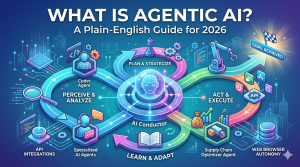
The real power of an AI agent emerges from how these three components interact in a continuous cycle:
- Perception: The agent observes its environment and current state
- Memory Consultation: The agent accesses relevant memories and knowledge to understand context
- Goal Evaluation: The agent assesses progress toward its goals
- Decision Making: The agent determines the best action based on goals, available tools, and memory
- Tool Utilization: The agent executes the chosen action using appropriate tools
- Outcome Observation: The agent monitors the results of its action
- Memory Update: The agent stores relevant information about the outcome
- Learning and Adaptation: The agent adjusts its future behavior based on results
Consider a customer service chatbot handling a support inquiry. Its goal is to resolve the customer’s issue quickly. It uses memory to recall previous interactions with this customer. It employs tools like knowledge bases and ticketing systems to investigate and resolve the problem. It learns from the outcome—whether the customer was satisfied—and adjusts its approach for future similar issues.
Real-World Examples of AI Agents
Autonomous Vehicles
Goals: Safely transport passengers from origin to destination, following traffic laws, avoiding accidents.
Tools: LIDAR sensors, cameras, GPS, decision-making algorithms, steering/acceleration/braking systems.
Memory: Maps of roads, traffic pattern data, previous driving scenarios, learned safety protocols.
Content Recommendation Systems
Goals: Suggest content users will enjoy, increase engagement time, optimize viewing satisfaction.
Tools: Machine learning models, user behavior analysis, content databases, ranking algorithms.
Memory: User preferences, viewing history, interaction patterns, content metadata.
Research and Development Automation
Goals: Conduct literature reviews, design experiments, analyze results, generate insights.
Tools: Search databases, data analysis software, simulation systems, scientific computing frameworks.
Memory: Literature databases, previous research findings, domain knowledge, experimental parameters.
Common Challenges and Solutions
Goal Misalignment
Challenge: When an agent optimizes for a stated goal but produces undesired side effects.
Solution: Use multi-objective optimization that balances multiple considerations; regularly audit agent behavior against intended outcomes.
Memory Limitations
Challenge: Agents may forget important information or confuse different contexts.
Solution: Implement robust memory architectures with clear organization and retrieval mechanisms; use attention mechanisms to prioritize relevant information.
Tool Reliability
Challenge: External tools may fail, return incorrect data, or become unavailable.
Solution: Build fallback mechanisms, validate tool outputs, implement error handling, and maintain alternative data sources.
Computational Cost
Challenge: Complex agents with sophisticated reasoning may be expensive to operate.
Solution: Optimize models, use caching and memoization, implement tiered decision-making based on complexity needed.
Frequently Asked Questions
What is the difference between an AI agent and machine learning model?
A machine learning model is a mathematical function trained on data to make predictions or classifications. An AI agent is a broader system that combines perception, reasoning, memory, and action. An agent may use machine learning models as one of its tools, but agents add autonomy, goal-directed behavior, and adaptive learning over time. While a machine learning model might predict what a customer wants to buy, an AI agent could autonomously manage an entire customer interaction from start to finish, learn from outcomes, and improve its approach.
Can an AI agent have conflicting goals?
Yes, and this is actually quite common in real-world applications. For example, a chatbot might have the goal of resolving issues quickly while also maximizing customer satisfaction. These can sometimes conflict—rushing through a conversation might resolve it faster but reduce satisfaction. Advanced AI agents use techniques like multi-objective optimization and constraint satisfaction to balance competing goals. The relative importance of each goal can be weighted based on organizational priorities.
How do AI agents learn and improve over time?
AI agents improve through several mechanisms: reinforcement learning (receiving rewards or penalties for outcomes), supervised learning (learning from labeled examples provided by humans), unsupervised learning (discovering patterns in data), and experience replay (analyzing past interactions to extract lessons). Memory systems play a crucial role—by storing information about previous attempts and their outcomes, agents can identify patterns, avoid repeating mistakes, and refine their strategies. Some agents also learn from feedback provided by users or supervisors.
What are the ethical considerations with AI agents?
Because AI agents operate autonomously with real-world consequences, several ethical concerns arise: ensuring goals align with human values, preventing unintended harmful outcomes, maintaining transparency in agent decision-making, protecting user privacy (especially regarding memory systems), preventing misuse, and ensuring fairness and non-discrimination. As agents become more capable, alignment between agent goals and human values becomes increasingly important. Regular auditing, clear accountability structures, and thoughtful goal definition are essential safeguards.
Conclusion
Understanding the anatomy of an AI agent—its goals, tools, and memory systems—is essential for comprehending how modern artificial intelligence works. These three components don’t operate in isolation; instead, they form an integrated system where goals provide direction, tools enable action, and memory facilitates learning and adaptation.
As AI agents become increasingly prevalent in business, healthcare, transportation, and countless other domains, the importance of understanding these fundamentals only grows. Whether you’re developing AI systems, implementing them in your organization, or simply trying to understand the technology shaping our world, grasping these core concepts provides valuable insight.
The future will likely bring even more sophisticated agents with richer goals, more powerful tools, and more intelligent memory systems. By understanding the principles today, you’ll be better equipped to work with and shape these technologies as they evolve.
About the Author
This article was written by an AI technology specialist with expertise in agentic systems, machine learning, and artificial intelligence applications. The author has spent over five years researching and documenting how AI agents are transforming industries, with a focus on helping both technical and non-technical audiences understand complex AI concepts. This content represents current best practices and research