- Key Takeaways
- Table of Contents
- Understanding What AI Agents Are
- Core Decision-Making Mechanisms
- Perception and Sensing
- Processing and Analysis
- Decision Selection
- Action Execution
- The Role of Reinforcement Learning
- How Neural Networks Enable Independent Thinking
- Goal-Oriented Architecture and Autonomy
- Primary Objectives
- Sub-Goals and Planning
- Long-Term versus Short-Term Thinking
- Safety Mechanisms and Decision Constraints
- Hard Constraints
- Value Alignment
- Monitoring and Intervention
- Uncertainty Handling
- Real-World Examples of AI Agents
- Autonomous Vehicles
- Chess and Game-Playing Engines
- Recommendation Systems
- Trading Algorithms
- Frequently Asked Questions
- How do AI agents know what's right or wrong if nobody tells them?
- Can AI agents make mistakes in their decisions?
- What stops AI agents from making dangerous decisions?
- How is AI agent decision-making different from human decision-making?
- Author Bio
“`html
How AI agents make decisions without human input
Artificial intelligence has evolved dramatically over the past few years, moving from simple rule-based systems to autonomous agents capable of making complex decisions independently. If you’ve wondered how these AI agents can operate without constant human oversight, you’re not alone. Understanding this process reveals fascinating insights into modern machine learning and autonomous systems.
Key Takeaways
- AI agents use decision trees and algorithms to evaluate multiple options and select the best course of action based on their training
- Reinforcement learning allows agents to learn from experience and improve decisions over time without human intervention
- Neural networks and deep learning enable agents to recognize patterns and make nuanced decisions in complex environments
- Goal-based architecture gives agents clear objectives they work toward autonomously
- Safety mechanisms and constraints are built into agents to ensure decisions stay within acceptable boundaries
Table of Contents
- Understanding What AI Agents Are
- Core Decision-Making Mechanisms
- The Role of Reinforcement Learning
- How Neural Networks Enable Independent Thinking
- Goal-Oriented Architecture and Autonomy
- Safety Mechanisms and Decision Constraints
- Real-World Examples of AI Agents
- Frequently Asked Questions
- Author Bio
Understanding What AI Agents Are
An AI agent is essentially a software program designed to perceive its environment, process information, and take autonomous actions to achieve specific goals. Unlike traditional software that follows predetermined rules, AI agents can adapt, learn, and make decisions based on complex data inputs without waiting for human instruction.
The key difference between AI agents and conventional programs lies in their autonomy and intelligence. A traditional program executes commands in a linear fashion. An AI agent, by contrast, continuously monitors its environment, evaluates situations, and makes independent choices about how to proceed.
AI agents exist across many industries today:
- Autonomous vehicles navigating city streets
- Chatbots handling customer service inquiries
- Trading algorithms making financial decisions
- Robotic process automation handling business workflows
- Game-playing AI competing at the highest levels
Core Decision-Making Mechanisms
At the foundation of every AI agent’s decision-making process are several core mechanisms that work together to enable autonomous choice-making.
Perception and Sensing
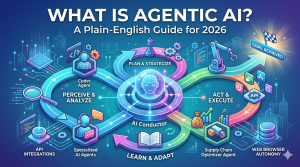
Before an AI agent can make any decision, it must first understand its environment. This happens through sensors and data inputs—whether that’s cameras for a self-driving car, text inputs for a language model, or market data for a trading bot. The agent continuously collects information about the world around it.
Processing and Analysis
Once the agent perceives information, it processes this data through trained models. These models have been developed using machine learning techniques during an initial training phase. The agent evaluates multiple possible actions and their likely outcomes—this is where the actual “thinking” happens.
Decision Selection
Based on its analysis, the agent selects an action to execute. This selection happens through various algorithms, most commonly through probability scoring where the agent chooses the option with the highest expected value. For instance, a recommendation system might calculate that a particular item has a 78% chance of matching user preferences, making it the strongest choice among alternatives.
Action Execution
Finally, the agent executes its chosen action. This might mean sending a message, moving a robotic arm, executing a trade, or presenting information to a user.
The Role of Reinforcement Learning
One of the most powerful techniques enabling AI agents to make independent decisions is reinforcement learning. This approach fundamentally changes how agents improve their decision-making without human intervention.
Reinforcement learning works by giving agents feedback on their actions in the form of rewards and penalties. When an agent makes a good decision, it receives a positive reward signal. When it makes a poor choice, it receives a penalty. Over thousands or millions of iterations, the agent learns which decisions lead to better outcomes.
Consider a game-playing AI. Rather than being programmed with explicit strategies, the agent plays thousands of games against itself. Each move generates feedback—did that move lead closer to winning or further away? The agent gradually refines its strategy, discovering winning approaches that humans might never have explicitly programmed.
This learning process enables several important capabilities:
- Adaptation to new situations: The agent can apply learned principles to scenarios it hasn’t explicitly encountered before
- Continuous improvement: The agent gets progressively better at decision-making without human retraining
- Exploration and discovery: The agent can find innovative solutions that weren’t in its original training data
- Autonomous optimization: The agent automatically works toward maximizing its reward signal
How Neural Networks Enable Independent Thinking
Neural networks are the computational structures that power most modern AI agents. Loosely inspired by how biological brains work, neural networks consist of interconnected layers of mathematical operations that transform input data into useful predictions and decisions.
What makes neural networks so powerful for independent decision-making is their ability to recognize complex patterns in data. Rather than being explicitly programmed with rules like “if A then B,” neural networks learn patterns from examples. A medical AI doesn’t receive rules about what indicates cancer; instead, it learns to recognize patterns in thousands of medical images.
Deep learning, which uses neural networks with many layers, enables even more sophisticated pattern recognition. These networks can process information through multiple levels of abstraction, similar to how your brain might recognize a face by first identifying edges, then features, then the complete pattern.
This capability means agents can:
- Handle ambiguous or incomplete information
- Make decisions based on subtle patterns humans might miss
- Process natural language and understand context
- Adapt decisions based on the specific context of a situation
Goal-Oriented Architecture and Autonomy
A crucial component of autonomous AI agent decision-making is a clear goal structure. Agents operate most effectively when they have well-defined objectives they work toward independently.
This goal-oriented approach works in several ways:
Primary Objectives
The agent is given a primary goal—maximize customer satisfaction, complete a task efficiently, achieve a game objective, or optimize a metric. Everything the agent does is measured against this fundamental goal.
Sub-Goals and Planning
Complex goals require breaking down into smaller sub-goals. An autonomous vehicle’s primary goal is safe transportation, which breaks down into maintaining safe speed, monitoring traffic, detecting obstacles, and following traffic rules. The agent dynamically prioritizes among these sub-goals based on current conditions.
Long-Term versus Short-Term Thinking
Sophisticated agents balance immediate rewards against long-term benefits. An agent might choose a slightly suboptimal immediate action because it knows this action leads to better overall outcomes down the line. This requires the agent to model consequences and plan ahead independently.
Safety Mechanisms and Decision Constraints
Autonomous decision-making doesn’t mean completely uncontrolled decision-making. Responsible AI agent design includes safety constraints and guardrails that ensure agents’ independent decisions stay within acceptable boundaries.
These safety mechanisms include:
Hard Constraints
Hard constraints are absolute rules the agent cannot violate. An autonomous vehicle has hard constraints against driving through red lights or into oncoming traffic. A medical AI has constraints against recommending dangerous drug interactions. These aren’t learned preferences—they’re built-in boundaries.
Value Alignment
Agents are designed with value functions that align their objectives with human values. Rather than purely optimizing for a single metric, agents learn to balance multiple objectives—efficiency, safety, fairness, and ethics.
Monitoring and Intervention
Many AI agents include monitoring systems that flag unusual behavior patterns. If an agent starts making decisions that deviate significantly from expected patterns, humans can be alerted for review and potential intervention.
Uncertainty Handling
Rather than acting with false confidence, well-designed agents acknowledge uncertainty in their decisions. When confidence falls below a threshold, agents may request human input or default to safer conservative choices.
Real-World Examples of AI Agents
Understanding how autonomous decision-making works becomes clearer through concrete examples.
Autonomous Vehicles
Self-driving cars are among the most complex AI agents operating today. They continuously perceive their environment through cameras, radar, and lidar sensors. Using deep neural networks trained on millions of miles of driving data, they make split-second decisions about acceleration, braking, and steering. Their goal is safe transportation, which involves multiple sub-goals and constraints. Yet they operate with significant autonomy, making decisions thousands of times per second without human input.
Chess and Game-Playing Engines
Systems like chess engines and Go-playing AIs demonstrate decision-making at an intellectual level. These agents use tree search algorithms combined with neural networks to evaluate millions of possible move sequences. They independently determine the best moves without consulting humans, often discovering strategies that top human players had never considered.
Recommendation Systems
When Netflix or Spotify recommends content, they’re using AI agents that make autonomous decisions about what you might enjoy. These agents analyze your behavior patterns, compare them to millions of other users, and use neural networks to predict your preferences—all without human intervention in individual recommendations.
Trading Algorithms
Financial markets use AI agents that make autonomous trading decisions, executing thousands of trades per second. These agents analyze market data, assess risk, and execute decisions in milliseconds—far faster than any human could manage. They operate within predetermined constraints and risk limits but otherwise function completely autonomously.
Frequently Asked Questions
How do AI agents know what’s right or wrong if nobody tells them?
AI agents determine right and wrong through their training process. During training, they receive feedback signals—rewards for good decisions and penalties for bad ones. They learn to associate certain patterns and actions with positive outcomes. Additionally, developers build in explicit values and constraints that represent what humans consider right or wrong for that specific application. The agent’s goal function encodes these values mathematically.
Can AI agents make mistakes in their decisions?
Absolutely. AI agents make mistakes regularly. No decision-making system, human or artificial, is perfect. Agents make errors when they encounter situations different from their training data, when their training data was biased, or when their learned patterns were insufficient. This is why many AI systems are designed with human oversight, especially for high-stakes decisions. As agents gain more diverse training experiences, their error rates typically decrease.
What stops AI agents from making dangerous decisions?
Multiple safeguards prevent dangerous autonomous decisions. Hard constraints built into the system prevent the most critical harmful actions. Value alignment training teaches agents to balance multiple objectives including safety. Uncertainty thresholds trigger human review when the agent isn’t sufficiently confident. Regular monitoring detects anomalous behavior patterns. Additionally, agents are designed with the ability to defer to humans when appropriate. It’s a multi-layered approach rather than relying on any single safety mechanism.
How is AI agent decision-making different from human decision-making?
AI agents and humans decide differently in several ways. Agents can process vastly larger amounts of data and identify patterns at scales humans can’t. They make decisions without fatigue, emotion, or bias (though they can have different types of bias from their training data). Agents can operate at inhuman speeds, making decisions in milliseconds. However, humans excel at reasoning about novel situations, understanding context and nuance, and applying values and ethics to ambiguous scenarios. The best outcomes often come from combining both approaches—AI handling data-intensive analysis and rapid execution, humans providing oversight and judgment on complex values.
Author Bio
About the Author: This article was written by a technology writer and AI researcher with over eight years of experience covering artificial intelligence, machine learning, and autonomous systems. The author has studied AI decision-making mechanisms at both industry and academic levels, and regularly writes about how AI technologies impact business and society. When not writing about AI, they enjoy exploring how emerging technologies reshape human interaction with machines.
“`