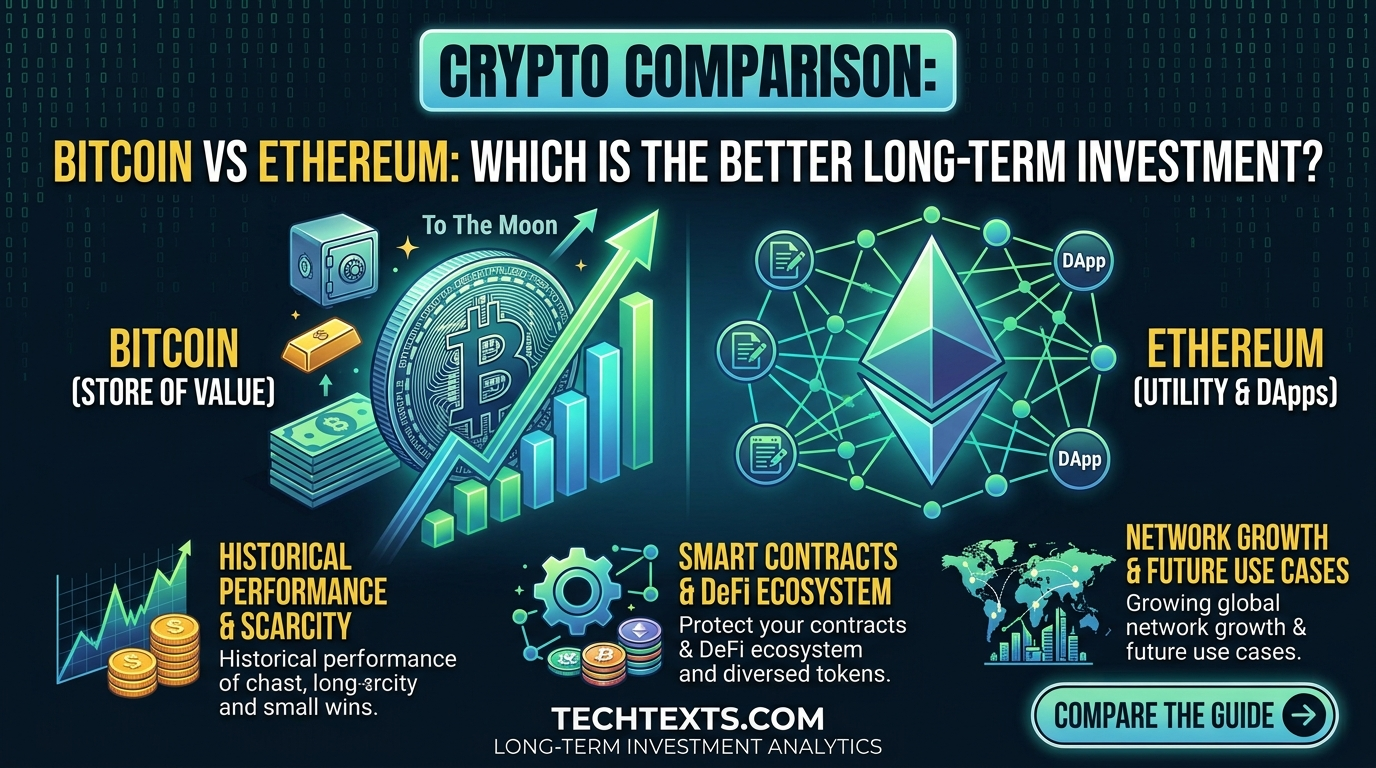
- Key Takeaways
- Understanding Bitcoin and Ethereum
- What is Bitcoin?
- What is Ethereum?
- Market Capitalization and Adoption in 2026
- Institutional Adoption
- Why Has Ethereum Fallen So Much Further Than Bitcoin?
- Technology and Use Cases
- Bitcoin's Technology and Purpose
- Ethereum's Technology and Ecosystem
- Price Volatility and Risk Profile
- Staking, Yield, and Income Potential
- Regulatory Landscape in 2026
- Future Potential and Innovation
- Bitcoin's Evolution
- Ethereum's Growth Opportunities
- Head-to-Head Comparison
- Making Your Investment Decision
- Choose Bitcoin If You:
- Choose Ethereum If You:
- A Note on Portfolio Allocation
- Frequently Asked Questions
- Q: Is Bitcoin or Ethereum better for beginners?
- Q: Can I profit more from Ethereum than Bitcoin?
- Q: Why has Ethereum fallen so much more than Bitcoin in 2026?
- Q: Does Ethereum's price drop mean the network has failed?
- Q: Should I buy Ethereum now because it's "cheap" compared to its 2025 high?
- Q: How much of my portfolio should be in crypto at all?
- Conclusion
Key Takeaways
- Bitcoin (BTC) remains the largest cryptocurrency by market capitalization — around $1.2–1.3 trillion as of mid-2026 — and continues to function primarily as a store of value and “digital gold.”
- Ethereum (ETH) is the leading smart contract platform, but 2026 has been a brutal year for its price: ETH has fallen roughly 60–68% from its August 2025 all-time high near $4,950, with a market cap now closer to $200–230 billion.
- Bitcoin has outperformed Ethereum significantly through this cycle, with the ETH/BTC ratio sitting near multi-year lows.
- Ethereum’s underperformance stems from a mix of macro pressure, sustained ETF outflows, competition from faster chains like Solana, and a structural issue where Layer-2 networks divert fee revenue away from Ethereum’s own mainnet.
- Despite the price weakness, Ethereum’s underlying network fundamentals — staking participation, developer activity, DeFi dominance — remain strong, creating a genuine divide between sentiment and fundamentals.
- The right choice still depends on your goals, risk tolerance, and time horizon — not on chasing whichever asset performed better last quarter.
Crypto prices are extremely volatile and can move significantly within days or even hours. The figures in this article reflect conditions as of early July 2026 and should be checked against a live source before making any decision.
Understanding Bitcoin and Ethereum
When considering long-term cryptocurrency investments, Bitcoin and Ethereum remain the two dominant players in the digital asset space — together still accounting for the majority of total crypto market value. However, they were built for fundamentally different purposes, and understanding that distinction matters more than simply comparing which one has gone up or down more this year.
What is Bitcoin?
Bitcoin, created by the pseudonymous Satoshi Nakamoto and launched in January 2009, is the world’s first and most well-known cryptocurrency. It operates as a peer-to-peer electronic cash system on a decentralized network secured by proof-of-work mining, where transactions are validated through energy-intensive computational competition. There will only ever be 21 million Bitcoin in circulation — a hard-coded, unchangeable supply cap that gives the asset its “digital gold” narrative. As of mid-2026, over 20 million BTC have already been mined, leaving less than a million left to be released gradually over the coming century.
What is Ethereum?
Ethereum, launched by Vitalik Buterin and a team of collaborators in 2015, is a decentralized platform that enables developers to build applications using smart contracts — self-executing code that runs exactly as programmed without a central authority. Unlike Bitcoin’s primary function as a store of value, Ethereum serves as programmable infrastructure for decentralized applications (dApps), decentralized finance (DeFi), and increasingly, tokenized real-world assets. In September 2022, Ethereum transitioned from proof-of-work to proof-of-stake in an event known as “The Merge,” cutting its energy consumption by over 99% while maintaining network security through staked ETH rather than mining hardware.
Market Capitalization and Adoption in 2026
Market capitalization remains a useful, if imperfect, indicator of an asset’s maturity and market acceptance. As of early July 2026, Bitcoin holds a commanding lead with a market capitalization of approximately $1.2–1.3 trillion, with BTC trading in the low-to-mid $60,000s. This puts Bitcoin’s dominance of the total crypto market at a level rivaling — and by some measures exceeding — its historical highs.
Ethereum, by contrast, has had a genuinely difficult 2026. After peaking near $4,950–$4,954 in August 2025, ETH entered a prolonged and severe decline, falling as low as the $1,500–$1,600 range by mid-2026 before stabilizing somewhat around $1,550–$1,790. That puts Ethereum’s market capitalization at roughly $200–230 billion — down sharply from the ~$700 billion figure often cited from 2024, and a much smaller share of the total crypto market than it held during Ethereum’s stronger years. The ETH/BTC ratio, which measures Ethereum’s price purely against Bitcoin and strips out overall market direction, sits near multi-year lows, reflecting the scale of Ethereum’s underperformance rather than just a broad crypto downturn.
This is an important nuance for anyone comparing the two “as investments” in 2026: Bitcoin has broadly held its value and institutional standing through the year, while Ethereum has experienced one of the sharpest sustained drawdowns in its history. That doesn’t necessarily tell you which is the better long-term investment — cryptocurrency markets are cyclical, and recoveries have followed previous ETH drawdowns of similar severity — but it does mean any comparison using older 2024 figures is now significantly out of date.
Institutional Adoption
Bitcoin’s institutional adoption story has continued to mature. Spot Bitcoin ETFs, now approved and trading in multiple major markets, have become a primary channel for institutional capital, and corporate treasury holdings (led by firms like MicroStrategy/Strategy) remain a structural source of demand, even as some of these treasury buyers have reportedly begun trimming positions in 2026.
Ethereum’s institutional story in 2026 is more mixed. Spot Ethereum ETFs attracted meaningful cumulative inflows — reportedly over $11 billion by early 2026 — and staking-enabled ETF products launched during the year, creating a new category of yield-bearing crypto exposure. However, ETH-specific funds also experienced a stretch of consecutive months with net outflows as sentiment soured, even as some corporate buyers (such as Bitmine Immersion Technologies) reportedly used the price weakness to accumulate large ETH positions at a discount. This divergence — retail fear alongside pockets of institutional accumulation — is a recurring pattern in past Ethereum drawdowns.
Why Has Ethereum Fallen So Much Further Than Bitcoin?
Given how central this question has become to the Bitcoin-vs-Ethereum debate in 2026, it’s worth unpacking the specific factors analysts point to, rather than treating the decline as unexplained noise.
- Broader macro pressure. A risk-off environment across global markets in 2026 — driven by tariff concerns, interest rate uncertainty, and a cooling in speculative tech and AI-related investment — hit higher-beta assets like Ethereum harder than Bitcoin, which increasingly trades more like a macro hedge than a speculative tech asset.
- Sustained ETF outflows. Ethereum ETFs experienced a multi-month stretch of net withdrawals during the first half of 2026, removing a meaningful source of steady institutional demand.
- Layer-2 fee cannibalization. This is a genuinely Ethereum-specific issue: scaling solutions like Coinbase’s Base and other Layer-2 networks route enormous transaction volume away from Ethereum’s own mainnet, reducing the fees and “burn” that previously supported ETH’s price through its post-Merge deflationary mechanics. Some analysts have estimated this effect alone has removed tens of billions of dollars from Ethereum’s market capitalization.
- Competitive pressure from other chains. Faster, cheaper Layer-1 networks — particularly Solana — have captured a growing share of on-chain activity and developer attention, chipping away at the assumption that Ethereum will remain the default settlement layer for DeFi and tokenized assets.
- Leverage-driven liquidation cascades. Much of crypto trading happens on margin. When ETH breaks a key support level, leveraged positions get force-liquidated, which mechanically pushes the price down further and turns ordinary corrections into steeper crashes.
- Foundation-level uncertainty. Reports of Ethereum Foundation leadership departures and a shift toward “mild austerity” in its spending plans have added to a general sense of organizational uncertainty around the project, even though the underlying blockchain technology itself has not experienced any exploit or failure.
It’s worth being clear about what this decline is not: several analyses covering the crash explicitly note it was not caused by any technical failure, hack, or exploit of the Ethereum network itself. The blockchain has continued operating exactly as designed throughout the entire drawdown. The story here is almost entirely about capital flows, competitive positioning, and macro sentiment — not about Ethereum “not working.”
Technology and Use Cases
Bitcoin’s Technology and Purpose
Bitcoin’s technology is deliberately simple and narrowly focused, and that simplicity is itself a design philosophy. The Bitcoin network prioritizes:
- Security — an enormous amount of global computing power secures the network, making a direct attack on Bitcoin’s blockchain prohibitively expensive.
- Decentralization — thousands of full nodes distributed worldwide independently maintain and verify copies of the blockchain.
- Immutability — the historical transaction record cannot be altered without redoing all subsequent proof-of-work, which becomes exponentially harder the further back in history you’d need to rewrite.
- Scarcity — the fixed 21 million supply cap creates deliberate digital scarcity, reinforced by periodic “halving” events that cut new supply issuance roughly every four years.
Bitcoin deliberately avoids expanding its core functionality, treating this conservatism as a security feature rather than a limitation. Innovation happens mostly at the edges — through layer-2 solutions like the Lightning Network for faster micropayments — rather than through changes to the base protocol itself.
Ethereum’s Technology and Ecosystem
Ethereum’s architecture is far more complex, designed from the outset to support programmable applications rather than just value transfer. Key features include:
- Smart contracts — self-executing code that automates agreements, lending, trading, and countless other functions without intermediaries.
- Decentralized Finance (DeFi) — Ethereum remains the largest hub for DeFi lending, trading, and financial protocols, even as total value locked has fluctuated with the broader market downturn.
- The NFT ecosystem — Ethereum remains the primary blockchain underpinning digital art, collectibles, and increasingly, tokenized real-world assets.
- Layer-2 scaling networks — protocols like Arbitrum, Optimism, and Base enable dramatically faster and cheaper transactions, at the cost (as noted above) of diverting fee revenue away from Ethereum’s own base layer.
- Staking infrastructure — roughly 30% of all circulating ETH is currently staked, secured by over a million active validators, generating modest but real yield for long-term holders.
Ethereum’s ecosystem hosts thousands of active projects spanning decentralized finance, gaming, supply chain management, digital identity, and institutional experiments in tokenizing traditional financial assets — including reported involvement from major institutions exploring tokenized money-market funds on Ethereum’s infrastructure.
Price Volatility and Risk Profile
Historical data has long shown that Bitcoin exhibits somewhat lower volatility than Ethereum over extended periods, and 2026 has reinforced this pattern in dramatic fashion. While Bitcoin has also pulled back meaningfully from its own highs, its roughly 50%-range drawdown looks comparatively mild next to Ethereum’s 60–68% collapse from its August 2025 peak. This gap reflects several structural factors:
- Market maturity. Bitcoin’s longer track record and deeper institutional integration (through ETFs and corporate treasuries) attract capital that tends to be “stickier” during downturns.
- Beta to risk sentiment. Ethereum behaves more like a high-beta technology asset, meaning it tends to amplify both the upside and downside of broader risk-on/risk-off market swings.
- Structural fee dynamics. The Layer-2 cannibalization issue described above gives Ethereum a genuine fundamental headwind that Bitcoin simply doesn’t have, since Bitcoin has no comparable “fee-diverting” scaling ecosystem competing with its base layer.
- Correlation during crashes. Both assets are highly correlated during broad market sell-offs, but Ethereum has consistently shown sharper percentage declines during this cycle’s stress events.
For risk-averse investors with long time horizons, Bitcoin’s comparatively lower volatility profile may be more suitable, though it still comes with the possibility of significant drawdowns — this is crypto, not a savings account. Ethereum’s higher volatility means it can also stage sharper recoveries; several analysts covering the 2026 decline have pointed out that Ethereum’s on-chain fundamentals (staking growth, long-term holder accumulation) look stronger than its price action would suggest, which is exactly the kind of divergence that has preceded past ETH recoveries — though it is not a guarantee that this one will follow the same pattern.
Staking, Yield, and Income Potential
One practical difference that’s easy to overlook in a pure price comparison: Ethereum offers native staking yield, while Bitcoin does not.
Roughly 30% of Ethereum’s circulating supply is currently staked by validators securing the network, earning annual yields reported in the rough range of 2.8–3.5%, paid in ETH. This means Ethereum holders have a mechanism to earn a return on their holdings independent of price appreciation — either by running their own validator (which requires 32 ETH and technical setup) or by using a staking service or liquid staking token that handles the technical requirements in exchange for a fee.
Bitcoin has no equivalent native yield mechanism. Any “yield” on Bitcoin typically comes from third-party lending platforms, which carry counterparty risk that isn’t present in Ethereum’s protocol-level staking (though staking carries its own risks, including slashing penalties for validator misbehavior and smart contract risk for liquid staking derivatives). For investors specifically interested in generating income from their crypto holdings rather than purely speculating on price, this distinction is one of the more concrete practical differences between the two assets — separate from the ongoing price debate.
Regulatory Landscape in 2026
Regulatory clarity has improved for both assets compared to a few years ago, though neither is fully settled.
Bitcoin is generally recognized as a commodity in most major jurisdictions, which has simplified its treatment for ETF approval and institutional custody. Ethereum’s regulatory status has historically been murkier, given debates over whether its post-Merge proof-of-stake design makes it more security-like in nature. Ongoing legislative efforts — including proposed frameworks sometimes referred to in industry coverage as clarity-focused crypto legislation — aim to resolve some of this ambiguity, and their progress (or lack of it) has been cited by analysts as one of the swing factors in Ethereum’s 2026 price performance. Any material regulatory shift, positive or negative, is likely to affect Ethereum’s price more than Bitcoin’s, simply because more of Ethereum’s use case (DeFi, tokenization, smart contracts) intersects with areas regulators are actively scrutinizing.
Future Potential and Innovation
Bitcoin’s Evolution
Bitcoin’s future development continues to focus on incremental improvement rather than fundamental redesign. The Lightning Network and other layer-2 solutions aim to enable fast, cheap micropayments while preserving the base layer’s simplicity and security. Bitcoin has also become increasingly woven into traditional finance, with spot ETFs now well-established in multiple markets and continuing to serve as a primary institutional access point.
Ethereum’s Growth Opportunities
Ethereum’s roadmap remains active despite the price weakness. Upcoming upgrades — referred to in various 2026 coverage under names like the Fusaka, Glamsterdam, and Hegota proposals — target improved Layer-1 throughput, reduced fees, and better data availability, aiming directly at addressing the fee-cannibalization problem described earlier. The expansion of institutional tokenization projects, continued DeFi dominance, and growing staking participation all represent potential catalysts, though analyst forecasts for where ETH’s price ends up by year-end 2026 vary enormously — from cautious targets in the low $3,000s to far more aggressive projections in the five-figure range — which itself signals how genuinely uncertain the outlook is right now.
Head-to-Head Comparison
| Aspect | Bitcoin | Ethereum |
|---|---|---|
| Launch Year | 2009 | 2015 |
| Market Cap (mid-2026) | ~$1.2–1.3 Trillion | ~$200–230 Billion |
| Approx. Price (mid-2026) | ~$60,000–65,000 | ~$1,550–1,790 |
| Drawdown from cycle peak | ~50% | ~60–68% |
| Primary Use Case | Store of Value | Smart Contract Platform |
| Consensus Mechanism | Proof of Work | Proof of Stake (since 2022) |
| Native Yield | None (protocol-level) | ~2.8–3.5% via staking |
| Developer Ecosystem | Smaller, Bitcoin-focused | Extensive, DeFi and dApp focused |
| Regulatory Status | Generally recognized as a commodity | Status still evolving in several jurisdictions |
| Key 2026 Headwind | Relatively minor vs. ETH | Layer-2 fee cannibalization, ETF outflows, Solana competition |
Making Your Investment Decision
Choose Bitcoin If You:
- Prefer a more conservative, comparatively lower-volatility asset aligned with the “store of value” philosophy.
- Believe in digital scarcity and want exposure to the “digital gold” narrative.
- Have a 10+ year investment horizon and can weather multiple full market cycles.
- Are uncomfortable with the technological complexity of Ethereum’s ecosystem, or don’t want to think about staking, validators, or Layer-2 dynamics.
- Want maximum institutional adoption and the clearest regulatory footing currently available in crypto.
Choose Ethereum If You:
- Can tolerate significantly higher volatility — including drawdowns like the one Ethereum has experienced in 2026 — in exchange for potentially higher long-term returns if the network’s fundamentals eventually reassert themselves.
- Believe in blockchain technology’s transformative potential for finance, and specifically in Ethereum’s continued role as the leading smart contract platform.
- Want exposure to DeFi, tokenized real-world assets, and native staking yield rather than pure price speculation.
- Are comfortable evaluating a genuinely contested thesis — analysts are more divided on Ethereum’s near-term direction right now than at almost any point in recent memory.
- Have a diversified portfolio with sufficient risk capacity to absorb a position that could fall significantly further before it recovers, if it recovers on the timeline you’re hoping for.
A Note on Portfolio Allocation
Many sophisticated investors avoid an all-or-nothing choice between Bitcoin and Ethereum, instead holding both with an allocation weighted toward Bitcoin — historically often cited in the range of 60–80% Bitcoin to 20–40% Ethereum, though the “right” split depends entirely on your own risk tolerance and conviction. Given Ethereum’s outsized volatility in 2026 specifically, some investors have leaned further toward Bitcoin this year, while others view the current ETH price weakness as exactly the kind of discount that makes a larger allocation attractive — a genuine, actively debated disagreement among experienced market participants rather than a settled question.
Whatever split you choose, position sizing matters more than most beginners initially appreciate: only invest money you can afford to lose entirely, and treat any specific price target you read — whether it’s a bearish $1,200 ETH scenario or a bullish $12,000 one — as one plausible scenario among several rather than a confident prediction of what will actually happen.
Frequently Asked Questions
Q: Is Bitcoin or Ethereum better for beginners?
A: Bitcoin is generally more suitable for beginners because of its simpler concept as digital money, comparatively lower volatility, and clearer regulatory status in most jurisdictions. Ethereum is better suited to those willing to learn about smart contracts, staking, and the broader DeFi ecosystem. Beginners should start with small amounts they can afford to lose and prioritize education before investing significant capital in either asset.
Q: Can I profit more from Ethereum than Bitcoin?
A: Historically, Ethereum’s higher volatility has produced larger percentage gains during bull markets — for example, ETH significantly outpaced Bitcoin’s returns during the 2020–2021 rally. However, 2026 has shown the other side of that same volatility: Ethereum has also fallen much further than Bitcoin during this downturn. Higher potential upside and higher potential downside are two sides of the same coin (no pun intended) with Ethereum, and that trade-off should factor directly into your decision rather than being an afterthought.
Q: Why has Ethereum fallen so much more than Bitcoin in 2026?
A: Analysts point to a combination of factors: sustained Ethereum ETF outflows, broader macro risk-off sentiment hitting higher-beta assets harder, competitive pressure from faster chains like Solana, and a structural issue where Ethereum’s own Layer-2 scaling networks divert transaction fees away from its base layer, weakening the deflationary mechanics introduced after The Merge. None of the coverage on this decline points to any technical failure of the Ethereum network itself — the blockchain has continued functioning exactly as designed throughout.
Q: Does Ethereum’s price drop mean the network has failed?
A: No. Multiple analyses of the 2026 decline are explicit that this was a market and sentiment-driven drawdown, not a technical or security failure. Staking participation, developer activity, and on-chain usage have remained relatively resilient even as the price fell sharply — creating the kind of gap between price and fundamentals that has historically (though not guaranteed to, going forward) preceded recoveries in Ethereum’s past cycles.
Q: Should I buy Ethereum now because it’s “cheap” compared to its 2025 high?
A: A lower price alone isn’t a reason to buy — plenty of assets fall further after already falling a lot. What matters is whether you believe the specific factors behind the decline (ETF flows, Layer-2 competition, macro sentiment) are likely to improve, and whether you can tolerate holding through further volatility if they don’t improve on your expected timeline. This is a judgment call with genuine uncertainty attached, not a question with a provably correct answer right now.
Q: How much of my portfolio should be in crypto at all?
A: This depends entirely on your personal financial situation, risk tolerance, and time horizon, and isn’t something a general article can responsibly answer for you. Many financial advisors who are open to crypto exposure suggest limiting it to a small percentage of an overall diversified portfolio, precisely because of the volatility both assets have demonstrated — Ethereum’s 2026 drawdown being a vivid recent example of why that caution exists.
Conclusion
The Bitcoin-versus-Ethereum comparison looks quite different in mid-2026 than it did even two years ago. Bitcoin has continued to consolidate its position as the more institutionally embraced, comparatively stable store-of-value asset, while Ethereum has been through one of the most severe drawdowns of its history — down 60–68% from its August 2025 peak — driven by a genuinely explainable mix of macro pressure, ETF outflows, competitive pressure, and structural fee dynamics rather than any failure of the technology itself.
Neither asset’s story is finished. Bitcoin’s simplicity and scarcity narrative remains intact and arguably strengthened through this cycle. Ethereum’s fundamentals — staking growth, developer activity, DeFi dominance — have shown more resilience than its price, setting up a genuinely contested debate among analysts about whether 2026’s weakness represents a buying opportunity or a warning sign of structural decline. Reasonable, well-informed people currently disagree about which is closer to the truth.
What hasn’t changed is the underlying advice: understand what you’re actually buying — a scarce, simple store of value in Bitcoin’s case, or a higher-risk, higher-complexity bet on programmable blockchain infrastructure in Ethereum’s case — size your position according to your own risk tolerance, and treat every specific price prediction you encounter, bullish or bearish, as one scenario among several rather than a certainty. This isn’t financial advice, and given how quickly both prices have moved in 2026 alone, always check current data before acting on anything in this article.